Narrows, MA 
Select a photograph to view a photo gallery


Photo Gallery


Photo Gallery
Photo Gallery
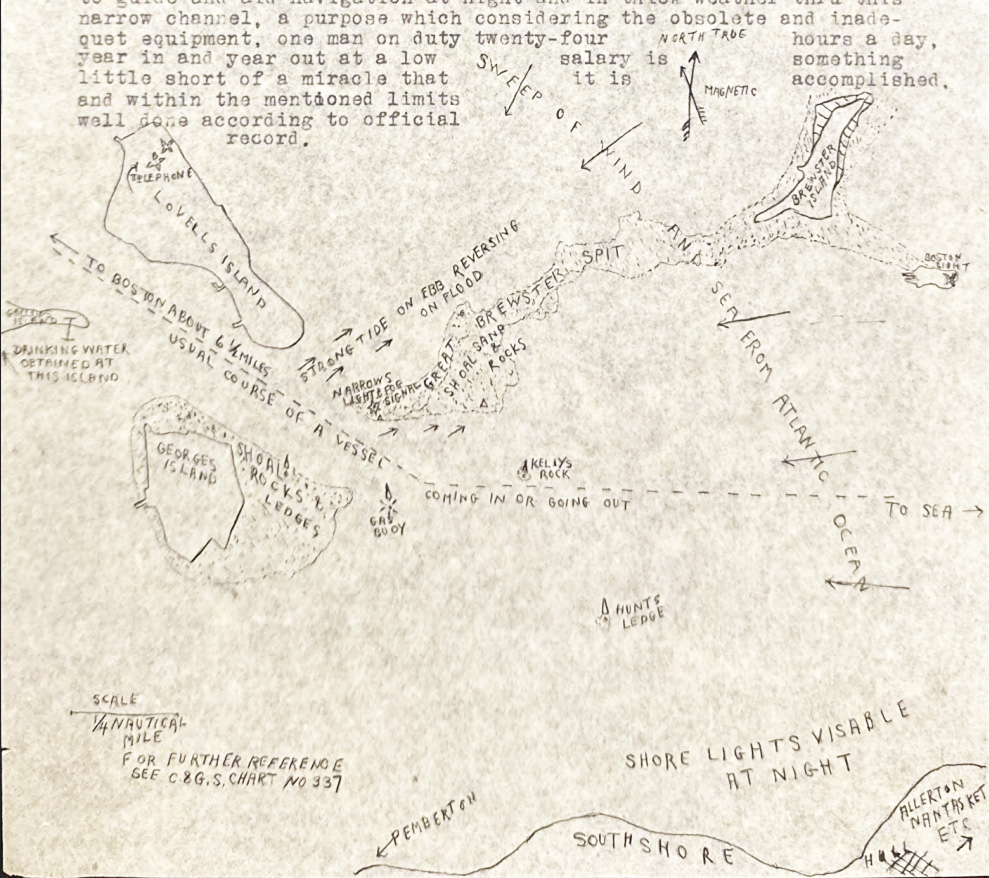
At the outer edge of Boston Harbor, where shifting sands, narrow channels, and hidden ledges long challenged mariners, the Narrows Light—better known as “Bug Light”—stood as one of the harbor’s most distinctive and essential aids to navigation. Perched on a narrow, curving sandspit extending from Great Brewster Island toward Lovells Island, the lighthouse marked the entrance to the Narrows Channel, once a principal route into the inner harbor. For more than seventy years, it guided vessels safely past the dangers of the spit and toward the busy port of Boston, while its keepers carried out acts of vigilance and bravery that became part of the station’s enduring legacy.
The hazards of the Narrows were recognized long before a formal lighthouse was erected. As early as 1778, charts showed an unlighted beacon at the end of the spit, warning mariners of the shoals and the nearby Harding’s Ledge. With maritime traffic increasing in the nineteenth century, Congress appropriated $15,000 on August 3, 1854, for the construction of a proper lighthouse at the site.
|
A contract was awarded to builder Harrison Loring on July 1, 1855, with the stipulation that the work be completed by December of that year. On August 1, 1856, a fixed red light was first exhibited from the structure, officially marking its entry into service.
The lighthouse was a screw-pile structure—an engineering solution well suited to the unstable sands of the spit. Seven iron piles supported a hexagonal wooden dwelling painted dark brown and topped with an iron lantern. Elevated approximately thirty-five feet above high water, the light was produced by a sixth-order lens and could be seen for about seven nautical miles. Its red color distinguished it from other nearby lights and helped mariners identify their position.
The light served a precise navigational purpose. When aligned with Long Island Head Light, it created a range that guided vessels safely past Harding’s Ledge and through the channel. In fog, a bell mounted on the structure in 1881 sounded at regular intervals, providing an audible warning when visibility failed.
The first keeper associated with the station was Henry L. Studley, who had previously been in charge of the lightship at Minot’s Ledge. He resigned after a few months and was replaced by Nathaniel R. Hooper, who served for most of the period from 1856 to 1871 and provided stability during the station’s formative years.
Life at Narrows Light was both isolated and physically demanding. The dwelling, raised above the water on iron piles, offered little protection from the elements. Winter storms coated the structure in ice, and waves sometimes surged beneath the floorboards. The only heat came from a stove, and supplies had to be brought by boat in all weather conditions. During severe storms, keepers could be cut off for days at a time.
The structure itself required constant maintenance. In 1863, it was struck by a vessel and significantly damaged, necessitating repairs to both its iron foundation and wooden superstructure. Ice posed an ongoing threat, leading to the construction of a protective icebreaker—an arrangement of heavy oak piles, stone ballast, and iron sheathing designed to deflect drifting ice. This barrier was itself destroyed and rebuilt more than once, reflecting the relentless forces at work in the harbor.
Throughout the late nineteenth century, the lighthouse underwent periodic upgrades. In 1871, repairs were made to the platform, railings, and shutters, and a more powerful fifth-order lens replaced the original sixth-order apparatus. Additional improvements included repainting, structural reinforcements, and adjustments to the fog-bell machinery.
In 1886, the lantern deck, stairs, and railings were renewed, and in 1900 a 600-gallon water tank was installed to improve living conditions. A lightning conductor was added in 1889, and the icebreaker continued to be repaired and strengthened as needed.
Despite these improvements, the station remained vulnerable. Storms repeatedly damaged the structure, and the exposed location ensured that upkeep was a constant necessity. Yet the lighthouse continued to fulfill its role, guiding countless vessels safely through the Narrows.
While the light itself was vital, the human element at Narrows Light was equally important. Its keepers were often called upon to assist vessels in distress, and their actions saved numerous lives.
In August 1915, Keeper Malcolm N. Huse demonstrated exceptional vigilance and courage. On August 13, he aided the launch Nautilus, which had gone ashore on Lovells Island, preventing it from capsizing as the tide fell. Two days later, he assisted three individuals aboard a disabled motorboat. These back-to-back rescues earned him official commendation and highlighted the critical role keepers played beyond maintaining the light.
|
Keeper Arthur A. Small, who served from 1917 to 1922, continued this tradition of service. In 1920, he piloted the steamer Mondoir safely to Boston after its captain lost his bearings. That same year, he assisted the motor yacht Alert, which had run onto a ledge with seven passengers aboard. In February 1921, he rescued a capsized assistant keeper from Boston Light, recovering both the man and his boat.
One of the most dramatic rescues occurred in December 1921. On a bitter winter night, Small heard cries for help over the wind. Rushing out without even stopping to fully dress, he found a half-frozen fisherman covered with ice who had swum ashore and was attempting to climb the ladder to the station. After bringing the man inside, Small returned to the shore and located a boat in the breakers with two more men clinging to it. In darkness and freezing conditions, he managed to bring them safely ashore. He secured their vessel with a kedge anchor and provided the men with hot drinks, dry clothing, and warmth until they recovered. The incident remains one of the most vivid examples of lifesaving in the history of the station.
Tom Small, Arthur’s brother and the final keeper of Narrows Light, continued this legacy. In February 1923, he rescued a man trapped in a rowboat drifting toward the open sea in an ice floe. Later that year, he towed a disabled motor craft to safety. In 1925, he assisted a stranded Navy hydroplane, and in 1927 he helped refloat the fishing vessel Elmer S. in dense fog. His repeated interventions demonstrated both skill and dedication in hazardous conditions.
By the 1920s, Narrows Light had become widely known as “Bug Light,” a nickname inspired by its insect-like appearance—its dwelling perched atop slender iron piles. Despite its small size, it was a fully functioning home. The first floor contained a kitchen, dining area, and living space, while a tiny sleeping room was reached by ladder. Above it all sat the lantern.
Life for the keeper and his family could be both challenging and unique. During calm weather, they could walk the exposed sandspit at low tide, but during storms, waves swept over the structure, and the sea surged beneath their feet. The isolation fostered resilience and self-reliance, qualities essential for those entrusted with the station.
One day in February 1927, Tom Small went ashore for groceries and was unable to return to the lighthouse for several days due to bad weather. Tom’s wife Florence minded the light during her husband’s absence, sleeping days and staying up at night. “You'd think we would have enough of the ocean by the time we get vacation,” Florence told a reporter. “We haven't. We went to Newfoundland this year, Mr. Small and his brothers, in a chartered boat.”
When filling out a questionnaire in 1928, Keeper Small included a five-page, typewritten attachment as the form lacked sufficient space for him to provide an adequate job description. Until that year, Florence and their son James had lived with him at the tiny lighthouse, and Florence had acted as an unpaid assistant, but the pair now lived ashore so James could attend school.
“I am on duty twenty-four hours a day, indefinitely, been here going on six years, relieved by the Government ten days per year, any other relief is at my own expense,” Tom wrote. “This suggests itself, when does a man sleep in this constant tour of duty? Well, he don’t much, then half awake. … I set an alarm clock for about every two hours in clear weather, nights it is threatening I usually stay awake until the weather turns one way or another.”
Tom asked that an assistant be assigned to the station, but his request was denied. He was reminded that he was being paid more than any keeper at a shore station in the district, and that he knew the requirements of the station before accepting the position, his brother having served as his predecessor.
|
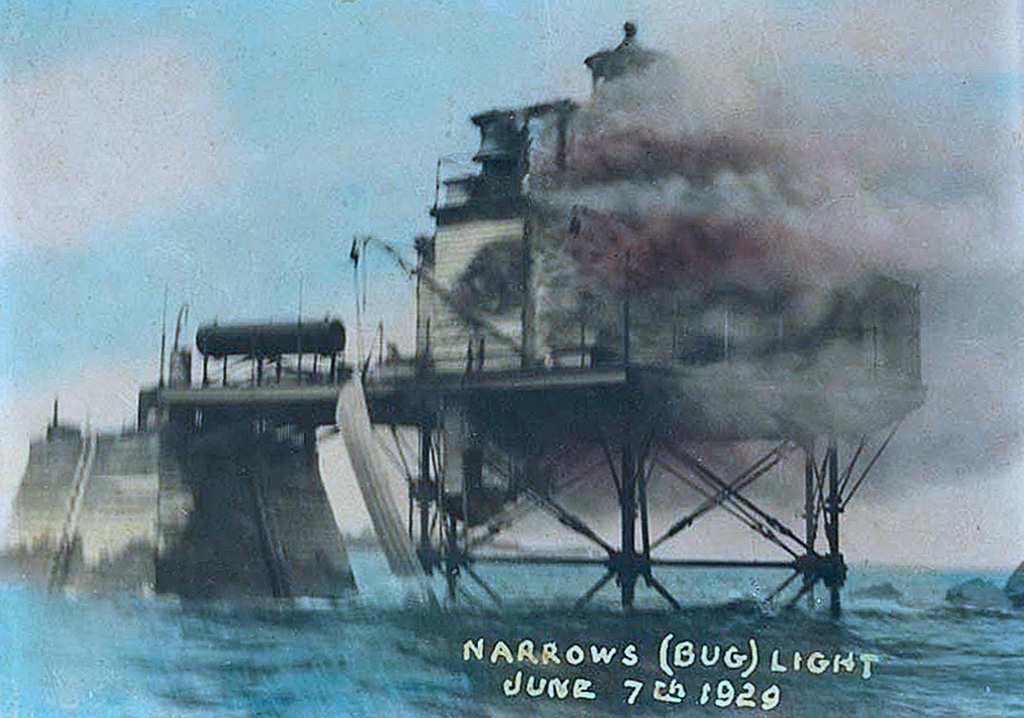
The long history of Narrows Light came to an abrupt end on June 7, 1929. Keeper Tom Small had been engaged in removing paint from the exterior of the wooden structure using a blowtorch. A spark ignited beneath the eaves, and the fire spread rapidly through the dry wood.
Within minutes, the entire lighthouse was engulfed in flames. Despite efforts by Small and responding crews from the Coast Guard and Boston fireboat services, the structure could not be saved. The lantern and heavy fog bell crashed down as the building collapsed, narrowly missing the keeper as he attempted to salvage belongings. He escaped in a small boat with only a few possessions.
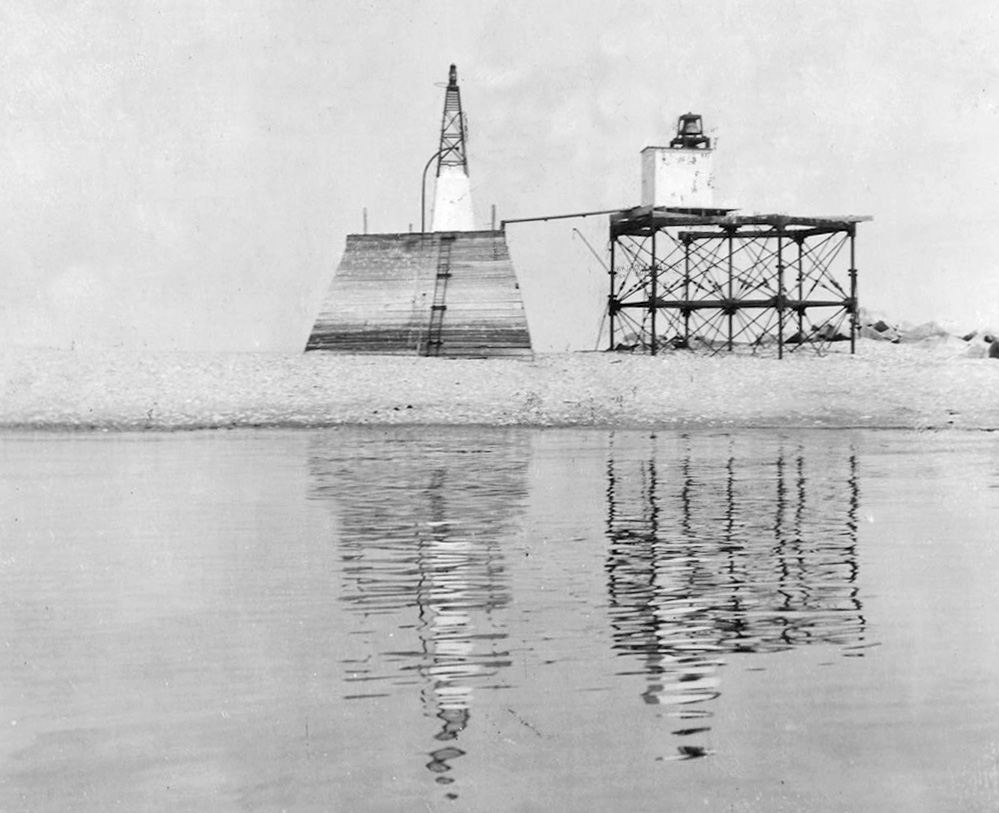
The destruction was total. Within hours, the once-familiar silhouette of Bug Light had vanished, leaving only a twisted framework. A temporary gas and bell buoy was quickly placed at the site to maintain navigational safety, later replaced by an automatic light and fog bell.
Keeper Small submitted a list of personal items lost in the fire that totaled $1,852.65. Senator David I. Walsh from Massachusetts introduced a bill to Congress to have Tom Small reimbursed, and the keeper ended up being awarded $1,000 for loss of furniture, clothing and other personal property.
As no position was immediately available for him, Keeper Small was briefly separated from the service before being offered a position as an additional keeper. He later served as an assistant at several stations before being in charge of Deer Island Lighthouse and Duxbury Pier Lighthouse.
Though the original structure no longer stands, the legacy of Narrows Light endures. For over seven decades, it served as a crucial guide through one of the most treacherous approaches to Boston Harbor. Its keepers, from Nathaniel R. Hooper to Tom Small, not only maintained the light but also acted as guardians of the sea, repeatedly risking their lives to aid others.
Today, a modern automated light marks the location where Bug Light once stood. While the physical structure is gone, its story—of ingenuity, endurance, and heroism—remains an integral part of the maritime history of Boston Harbor.
Henry L. Studley (1856), Nathaniel R. Hooper (1856 – 1861), C.J. Blair (1861 – 1862), Nathaniel R. Hooper (1862 – 1871), Charles J. Hooper (1871 – 1872), Daniel McKenzie (1872 – 1877), Frederick Hammond (1877 – 1878), E. Lewis Gorham (1878 – 1882), George G. Bailey (1882), Charles Friend (1882 – 1888), Charles E. Turner (1888 – 1892), Michael J. Curran (1892 – 1893), Samuel E. Liscom (1893 – 1895), Gershom C. Freeman (1895 – 1909), William H. Lowther (1909 – 1915), Malcolm N. Huse (1915 – 1917), Charles A. Lyman (1917), Arthur A. Small (1917 – 1922), Tom Small (1922 – 1929).