Croatan, NC 
Select a photograph to view a photo gallery

Photo Gallery

Photo Gallery
Photo Gallery
Between the wooded shores of Roanoke Island and the North Carolina mainland stretches a broad, shifting body of water known as Croatan Sound, one of the most important inland passages along the state’s coast. Forming a vital link in the great chain of sheltered waters behind the Outer Banks, Croatan Sound connects Albemarle Sound to the north with the vast reaches of Pamlico Sound to the south. For centuries, mariners traveling between North Carolina’s interior ports and the Atlantic relied upon these protected waters, threading channels that wound among shoals, marshes, and hidden obstructions. Though safer than the open sea, the sounds presented dangers of their own. Shallow waters, shifting bottoms, sudden storms, dense fog, and submerged hazards demanded careful navigation. To aid mariners traversing this inland route, the federal government eventually established a succession of navigational aids in Croatan Sound, culminating in one of North Carolina’s distinctive screw-pile lighthouses: Croatan Lighthouse.
The first federally authorized aid to navigation at Croatan Sound came not as a permanent structure but as a floating beacon. On March 3, 1835, Congress appropriated $5,000 for the placement of a light-vessel “on a proper site between Albemarle and Pamlico sounds.” Positioned near the head of Croatan Sound, the vessel occupied an essential point along the inland waterway where vessels transitioned between the broader sounds and the narrower channels surrounding Roanoke Island.
By the middle of the nineteenth century, the Croatan station was served by the Roanoke Island or Croatan Light-Vessel, a lead-colored vessel carrying a fixed light elevated thirty-one feet above the water and supplemented by a fog bell. Built in 1835, the vessel quickly became indispensable to navigators but suffered from the same chronic problems that plagued many American lightships. Constant exposure to weather, rot, and neglect rendered them expensive to maintain. An 1854 report lamented the poor condition of many light-vessels in the district but noted that the Croatan light-boat had been “thoroughly repaired” and returned to service after extensive work.
|
Even after repairs, federal officials increasingly regarded floating lights as an inefficient solution for North Carolina’s shallow inland waters. By 1857, Lighthouse Board reports concluded that many of the state’s aging light-vessels—including Croatan—should eventually be replaced with permanent screw-pile lighthouses. Engineers had already demonstrated the success of iron screw-pile foundations in the soft bottoms of coastal sounds and bays. Less expensive to maintain and more stable than lightships, these skeletal iron structures could be securely anchored in muddy shoals where conventional masonry towers were impossible.
In 1859, government engineers began boring at the sites of North Carolina light-vessels to determine their suitability for screw-pile foundations. The following year construction commenced at Croatan and nearby Long Shoal. On December 27, 1860, the Lighthouse Board formally announced that a new lighthouse had been erected at the head of Croatan Sound to replace the aging light-vessel.
The new station represented a remarkable feat of engineering for the era. Supported by a square iron screw-pile foundation driven into the soft bottom, the structure carried a wooden dwelling topped by a lantern housing a fourth-order Fresnel lens. The fixed white light stood approximately forty-five feet above mean sea level and could reportedly be seen eleven nautical miles under ordinary conditions. The lighthouse was first illuminated on January 20, 1861, and the venerable Croatan light-vessel was removed the following day, ending more than a quarter-century of floating service.
Unfortunately, the timing of the lighthouse’s debut could hardly have been worse. Within months, the nation descended into civil war. As Confederate authorities sought to deny navigational aids to Union forces, coastal lights throughout the South were extinguished. On January 13, 1862, Croatan Lighthouse appeared on an official list of North Carolina lights extinguished “by the rebels,” joining Cape Hatteras, Ocracoke, Cape Lookout, and numerous sound lights.
Union victories in coastal North Carolina soon restored federal control of much of the region, and efforts began to reestablish aids to navigation vital to military and commercial shipping. Temporary lighting returned to Croatan in 1862, followed later that year by the installation of a fifth-order Fresnel lens. By November 17, 1862, mariners once again saw a fixed white light burning over Croatan Sound. The following year federal reports confirmed that Croatan Lighthouse had been refitted and its light re-exhibited alongside those at Roanoke Marshes, Ocracoke, and Cape Lookout.
Yet wartime hazards remained. Keeper D. S. Dowdy, who served during the conflict, endured difficult conditions at the isolated station. Writing on August 12, 1864, he complained bitterly of the deteriorating structure: “We are going to have a hard time of it this winter here if we are not run away by the rain—this house leaks worse all the time and I shall not be able to keep a fire in rainy weather; if there is not something done to the house, it will be so no one can keep it.”
Dowdy’s troubles soon worsened dramatically. In October 1864, Confederate sailors connected with the ironclad ram Albemarle launched a daring raid into Croatan Sound. According to a report published in the New York Times, the raiders intended to seize a Union dispatch boat and destroy nearby vessels but ultimately succeeded in destroying Croatan Lighthouse itself, situated eight miles north of Roanoke Island. Dowdy and his wife were captured and taken prisoner, with the keeper remaining in captivity until March 2, 1865. Following the war, Dowdy sought compensation for the period during which he remained imprisoned by Confederate forces.
The destruction of the station temporarily darkened Croatan Sound once more, but federal authorities moved quickly to restore the light after the war. Notices to mariners announced that Croatan Lighthouse had been rebuilt and relighted on December 1, 1866. Standing thirty-five feet high and visible for ten miles, the restored lighthouse resumed its essential role along North Carolina’s inland route. Federal reports the following year noted that Croatan and Wade’s Point lighthouses—whose superstructures had been burned during the conflict—had been restored and relit.
For the next two decades, Croatan Lighthouse settled into the routine rhythms of life at an isolated sound station. Lighthouse Service personnel periodically repaired roofing, decking, lantern glazing, foundations, and living quarters. In 1882 a defective fog bell was replaced, while extensive repairs in 1883 included new flooring, decking, braces, and structural reinforcements that finally placed the station “in good condition.”
Despite these improvements, age and corrosion increasingly undermined the original structure. By the mid-1880s officials concluded that relocating Croatan Lighthouse to a more useful position would better serve navigation. Congress appropriated funds in 1884 for moving the station, but engineers soon discovered that dismantling and relocating the decaying wooden house and badly corroded screw-pile foundation would cost far more than constructing a replacement. Legal complications delayed work, but in 1886 Congress authorized the appropriation to be used for a new lighthouse instead.
Construction crews began work in 1887, assembling the frame superstructure at the Lazaretto Depot in Baltimore while transporting iron foundations to North Carolina waters. By June, workers had begun screwing the piles into place at the new site. Construction progressed rapidly. Although the lighthouse itself was not fully completed until July 30, 1887, the Fresnel lens from the old structure was transferred early enough for the new light to begin operating on July 15. The original station, having served for more than twenty-five years, was then dismantled.
The rebuilt Croatan Lighthouse took the familiar form of North Carolina’s sound lights: a square white frame dwelling perched atop five iron screw piles, its brown-painted foundation rising above the water. A fog bell on the western side was struck every fifteen seconds during thick weather, guiding mariners through one of the state’s busiest inland channels.
As navigation in Croatan Sound grew increasingly sophisticated, the lighthouse evolved to meet changing demands. In 1891 officials introduced a red sector into the light, coordinated with a corresponding sector at nearby Roanoke Marshes Lighthouse. These intersecting beams warned mariners away from dangerous obstructions near Fulker Island. Vessels heading north could follow carefully prescribed instructions to remain clear of shoals by observing when the lights shifted between white and red.
Among the station’s many keepers, few left as enduring an impression as Ephraim Meekins, Jr. Born on Roanoke Island, Meekins began service at Croatan in 1887 as assistant keeper shortly after his marriage. In 1890 he became principal keeper and would remain closely associated with the station for much of his life, interrupted only by assignments at Cape Hatteras and Bodie Island. Returning to Croatan in 1919, he completed a remarkable lighthouse career spanning forty years.
The isolation of sound stations demanded unusual dedication from lighthouse keepers. Croatan stood in the sound, where it was exposed to storms, ice, fog, and collisions from passing vessels. Keepers regularly rendered aid to mariners in distress. In 1915 assistant keeper Isaac C. Meekins rescued Keeper Peter G. Gallop from drowning after Gallop fell overboard and struggled against the tide. Three years later, Isaac Meekins again demonstrated courage during severe weather, swimming to rescue a drowning woman and helping save three others after beaching the station boat during a storm. Lighthouse authorities formally commended him for remaining faithfully at his post during hazardous ice conditions in 1918, despite opportunities to leave.
Accidents also reminded keepers of the station’s vulnerability. Barges collided with the lighthouse in 1916 and again in 1917, damaging boats and portions of the structure. Assistant keeper Christopher C. Midgett, another veteran of the station, assisted disabled boaters on multiple occasions, reflecting the long tradition of service expected of sound-light keepers.
When Ephraim Meekins retired in January 1927, newspapers celebrated the quiet philosophy of a man who had spent decades tending isolated beacons. Reflecting on his years at Croatan, he offered a meditation on lighthouse life that perfectly captured the bonds between keepers and the mariners they served:
“Well, you can’t live in a lighthouse without being a good man,” Captain Eph assented. “You never get lonesome, out on the water, where you see boats going by, some of them old friends, some of them occasional friends, and others just newcomers, who pass you by, and maybe you don’t see them anymore. You learn to look for the old friends among the boats, and you get acquainted with their masters and the crews, and you like them all, because there is something deep down in the men who follow the water that brings all together. I think it is because if you have so many favors to do for them that you soon begin to take a great pleasure in helping them.
“It may not look like a big job, but I always thought there was something more in a job than the job itself. I always thought that even though I might have done better by going to see, I was doing as much good in the world where I was. Here on Roanoke Island I was always as good as anybody else. I’d rather be a big fish in a little puddle than a little fish in a big puddle. And the chances were that I could do more good right here.”
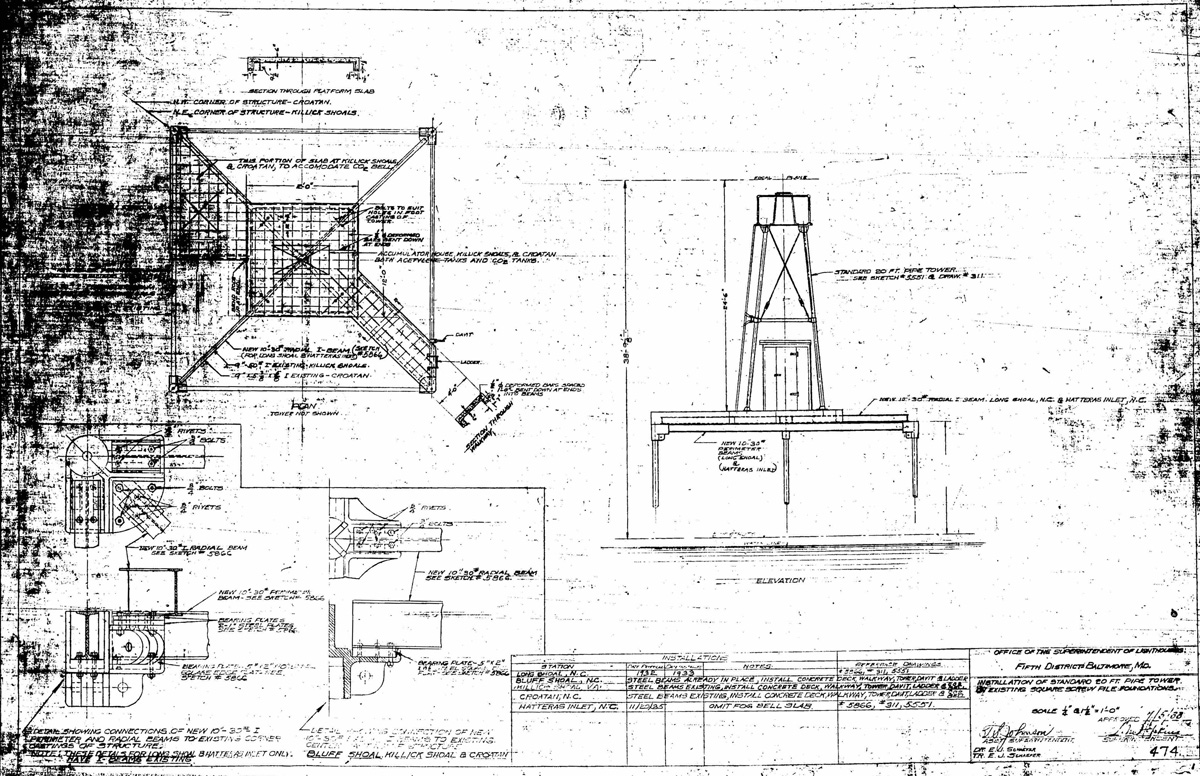
Modernization gradually transformed Croatan Lighthouse during the twentieth century. Improvements to the illuminating apparatus were undertaken in the 1930s, and in December 1934 officials modified both the light and fog signal. Finally, in 1939, the historic screw-pile dwelling gave way to a white skeletal tower standing on the old brown piles. The revised beacon displayed a flashing white light every five seconds, while a restored red sector continued warning mariners away from hazards in Croatan Sound.
Though physically altered, the station’s purpose remained unchanged. For generations, Croatan Lighthouse had guided vessels through the inland waters separating Roanoke Island from the mainland, serving fishermen, commercial traffic, government vessels, and coastal travelers navigating one of North Carolina’s most important maritime corridors. From its beginnings as a lonely lightship in 1835 to its modernized beacon of the twentieth century, Croatan Lighthouse stood as both guardian and companion to generations of watermen who crossed the broad, windswept waters between Albemarle and Pamlico Sounds.
Keepers:
References