Crabtree Ledge, ME 
Select a photograph to view a photo gallery


Photo Gallery


Photo Gallery
Photo Gallery
Crabtree Ledge Lighthouse served for forty-three years as a solitary sentinel in the northern reaches of Frenchman’s Bay, guarding the approach to Sullivan Harbor and serving the busy ferry route between Sullivan Harbor and Bar Harbor. Though modest in scale compared with some of Maine’s more famous lights, its history reflects the growth of coastal commerce, the ingenuity of late nineteenth-century lighthouse engineering, and the ever-present dangers faced by the men who tended it.
The danger posed by Crabtree Ledge was recognized long before a lighthouse rose from its rocks. In 1838, Lieutenant Thomas J. Manning, ordered by the Secretary of the Navy to survey the First Lighthouse District, recommended that an iron “trivet” with a basket-work top be placed on the southern end of the ledge. His suggestion reflected the limited resources and simpler aids to navigation of the era. No light was built at that time, and the ledge remained an unlighted obstruction for nearly half a century.
|
By the 1880s, however, circumstances had changed dramatically. The arrival of a branch of the Maine Central Railroad at Sullivan Harbor transformed the region. Passenger ferry traffic between the railroad terminus and Bar Harbor increased swiftly, with as many as fifteen to twenty steamer trips daily during the summer months. Lumber schooners and granite carriers also plied the waters. What had once been a local hazard now lay squarely in the path of regular commercial and passenger routes.
On March 25, 1886, Vice-Admiral S. C. Rowan, chairman of the Lighthouse Board, wrote to the Treasury Department recommending the establishment of both a light and fog signal on Crabtree Ledge. The Board concluded that the $10,000 initially proposed by Congress was inadequate and instead requested $25,000 to properly construct the station. Congress approved this larger appropriation on August 4, 1886.
Not everyone agreed that a lighthouse was the best solution. In December 1886, Major W. S. Stanton, engineer for the First and Second Lighthouse Districts, reported that only about 400 cubic yards of rock rose above a plane twelve feet below mean low water. He suggested that removing part of the ledge would cost less than erecting and maintaining a lighthouse. Because most steamers drawing ten feet or less could safely pass if the rock were lowered, he proposed that Congress consider blasting the obstruction instead.
Ultimately, the Lighthouse Board chose to proceed with construction. In 1887, the State of Maine conveyed title to the ledge to the United States, and plans were finalized. Bids revealed that the original $25,000 appropriation was insufficient, and Congress granted an additional $13,000 in October 1888.
Crabtree Ledge Lighthouse was built concurrently with lights at Lubec Narrows in Maine and Deer Island in Boston Harbor, all of similar design. A $12,550 contract for the metalwork needed at Crabtree Ledge was awarded to the Russel Wheel and Foundry Company of Detroit, while an erection contract of $19,000 went to Charles Lundberg of Chicago.
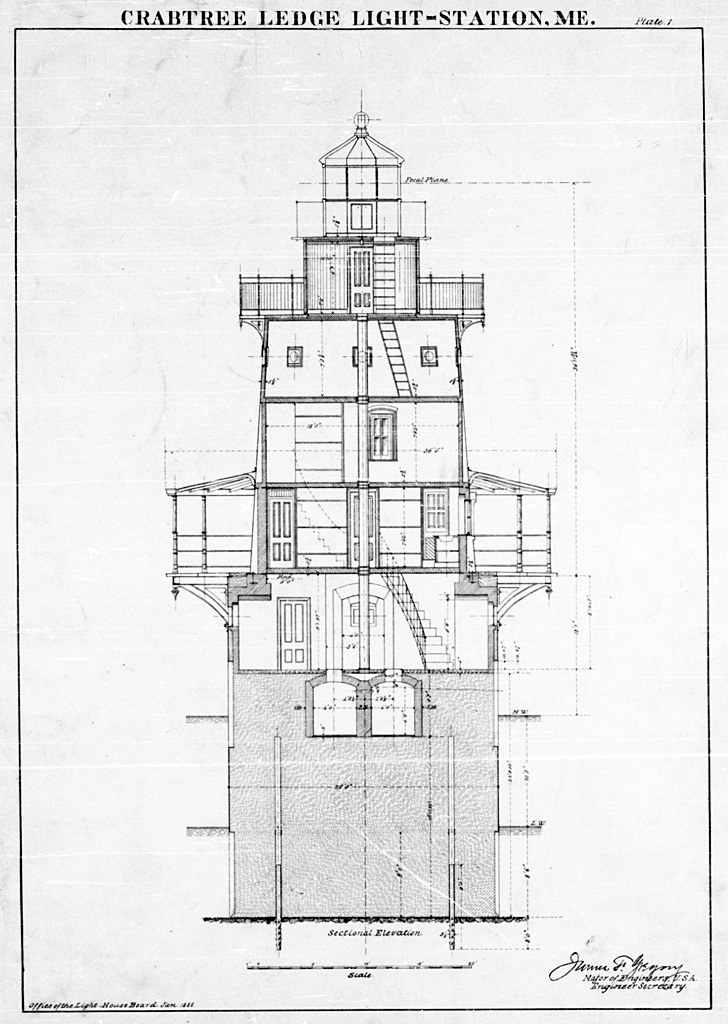
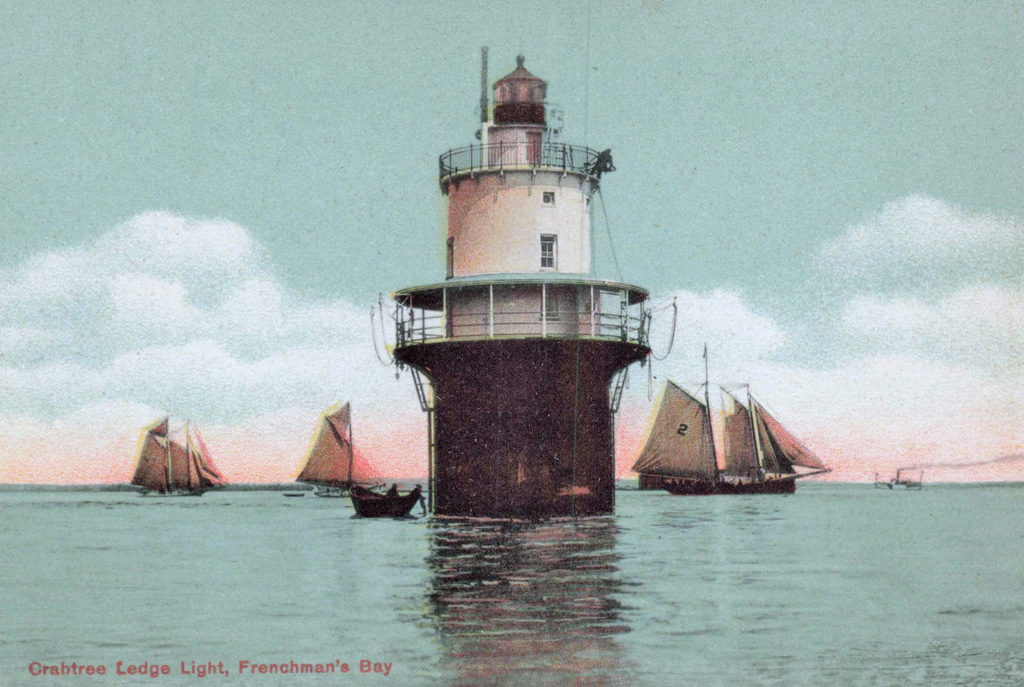
Crabtree Ledge Lighthouse consisted of a cylindrical iron caisson, twenty-five feet in diameter and thirty-two feet high, founded upon rock fifteen feet below mean sea level and filled with concrete. Above this rose a conical iron tower surmounted by a black lantern. The focal plane stood fifty-four feet above mean sea level.
On January 15, 1890, a fixed white fifth-order light, varied by a white flash every two minutes, was first exhibited using a fifth-order Henry-Lepaute Fresnel lens. A 1,200-pound bell, struck by machinery, was added later that year to serve as a fog signal. The tower was originally painted brown but was changed to white in 1903.
|
The first keeper, Amaziah R. Small, had previously served at Egg Rock Lighthouse. To accept the post at Crabtree Ledge, he took a pay reduction from $620 to $540 annually, preferring proximity to shore over higher wages. Small served faithfully until his death in 1898. The position of assistant keeper was added to the station in 1893.
Life at Crabtree Ledge required vigilance and seamanship. The landing ladder was often difficult to negotiate in rough seas. The station lay close to busy ferry routes, and on November 18, 1898, the steamer Sebenoa struck the lighthouse in broad daylight—an unusual and much-discussed accident. The vessel was run ashore and later repaired, while the lighthouse itself survived the collision with little damage.
Keeper Jerome H. Peasley, who was promoted from assistant to head keeper of the lighthouse in 1911, distinguished himself on several occasions. In 1913, he rendered aid to a man in danger of drowning; in 1914 he assisted in freeing the schooner-yacht White Wings from nearby rocks; and in 1916 he towed a disabled motorboat to safety. Yet despite such acts of rescue, tragedy would strike the station with heartbreaking repetition.
In late September 1916, Keeper Peasley was ill at his home ashore, and Assistant Keeper Chester D. Brinkworth was in charge of the station, assisted temporarily by his younger brother Leon. On the evening of September 29, Leon rowed ashore to purchase provisions and was seen returning to the light at dusk.
When the light continued burning well past its usual extinguishing time the next morning, concern grew. The lighthouse was found deserted. The station dory had drifted away and was later discovered waterlogged with damage to its bottom. A bottle of milk washed ashore intact—mute testimony to interrupted routine.
Investigations suggested that Leon, carrying supplies and holding the painter line, slipped while climbing the ladder and fell into the sea. Unable to swim, he likely cried out. Chester, described as a strong swimmer and capable boatman, leapt from the tower balcony to rescue him. It appears he struck the dory as he jumped, breaking his jaw and perhaps stunning himself before entering the water. Both brothers drowned within sight of shore.
Inspector Carl E. Sherman arrived aboard the tender Hibiscus to direct recovery efforts. Chester’s body was recovered on October 2; Leon’s followed two days later. The brothers, aged thirty-one and twenty, were buried beneath a shared headstone inscribed with tender lines of remembrance. Their deaths cast a pall over Hancock Point, where they were well known and deeply respected.
Joseph H. Brinkworth, father of Chester and Leon, entered the lighthouse service himself at the age of fifty-four in July 1917, less than a year after the drowning of his two sons. He served at Goose Rocks Lighthouse for a year and then was transferred to Crabtree Ledge Lighthouse. Serving where his sons did might have been cathartic or heartbreaking. Either way, Joseph resigned after two-and-a-half months at Crabtree Ledge due to sickness at home.
Less than six months after the drowning of the Brinkworth brothers, tragedy struck Crabtree Ledge again. Captain Joseph H. Whitmore, appointed assistant keeper in November 1916 after a lifetime at sea, attempted to land at the light on March 17, 1917, in a heavy southwest gale. As he lowered his sail near the tower, a sudden blast plunged the bow into a wave and knocked him overboard.
Keeper Peasley, witnessing the accident, rang the station’s bell four times to call assistance from shore and then launched a desperate rescue attempt in a small boat, rowing through treacherous seas. Whitmore tried to cling to the overturned boat but was repeatedly washed off. Despite Peasley’s heroic efforts, the fifty-six-year-old mariner drowned near the very spot where the Brinkworth brothers had perished.
Whitmore left behind a wife and children in Northeast Harbor and a reputation as one of the coast’s strongest and most respected captains. His death underscored the perilous nature of what seemed a near-shore assignment. Crabtree Ledge, only a short distance from land, proved no less dangerous than the open sea.
Over time, changes in transportation lessened the lighthouse’s importance. Ferry service declined, and by 1933 it had ceased altogether. On April 25, 1933, Crabtree Ledge Lighthouse was discontinued, and Head Keeper Thomas H. Morgan—who had served the station longer than anyone else—was furloughed. A bell buoy replaced the light.
The federal government later sold the structure. It was purchased for a reported $115 by Newbold Noyes of the Washington Star, who gifted it to his sons. Frederick S. Allis, Jr. acquired the lighthouse in 1936. He moved a reed organ into the lighthouse, but after he was marooned in the tower for several days during his honeymoon in 1939, he reportedly never set foot in the lighthouse again.
In February 1950, after standing guard for sixty years, the remains of the iron structure finally collapsed into Frenchman’s Bay during a winter storm. Its fall marked the end of a distinctive landmark at Hancock Point.