Shell Keys, LA 
Select a photograph to view a photo gallery

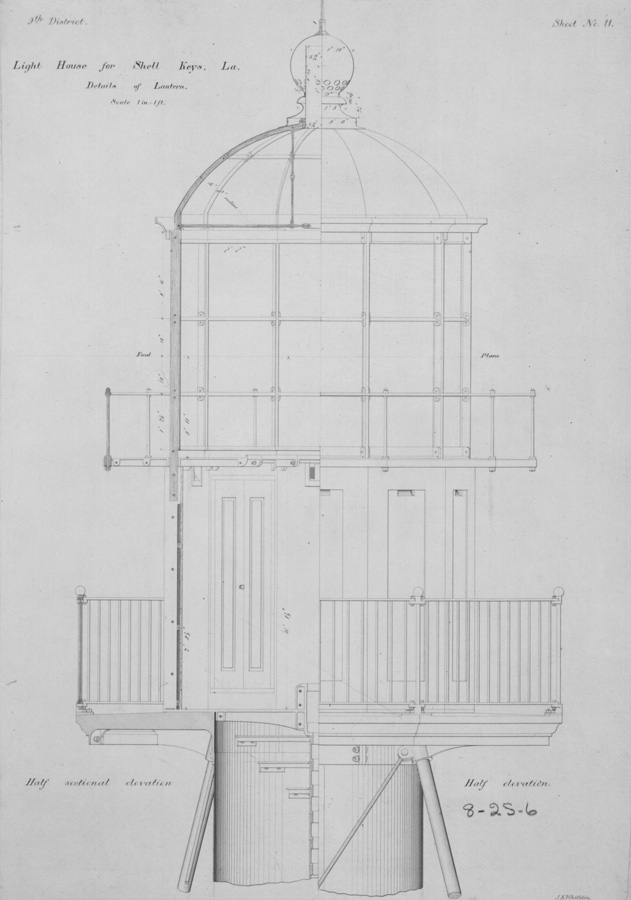
Photo Gallery

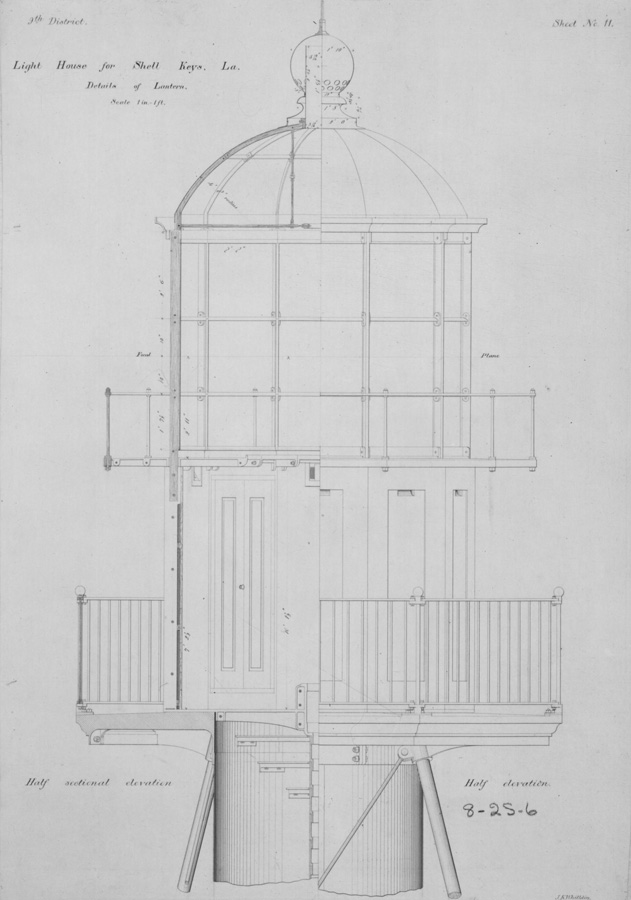
Photo Gallery
Photo Gallery
In response to repeated complaints from mariners and coastal interests, Congress authorized funds on August 3, 1854, “for a lighthouse on the Shell Keys, off Marsh Island, Louisiana,” appropriating $30,000 for its construction. The proposed light was intended not merely as a local beacon but as a key element in a broader chain of Gulf Coast aids that included Ship Shoal, Southwest Reef, and the Atchafalaya light-vessel. Lighthouse Board correspondence from the period makes clear that officials regarded the Shell Keys site as superior to the existing Vermilion Bay Lighthouse, which marked an entrance seldom used by deep-draft vessels. A light on the Shell Keys, they argued, would serve both general coastwise navigation and the heavy coasting trade bound through Atchafalaya Bay.
|
Bids for Shell Keys Lighthouse were opened at the Lighthouse Board in Washington on June 1, 1858, drawing proposals from ironworks across the northeastern United States. The highest bid was $24,390, but the contract went to J. Morton Poole & Co. of Wilmington, Delaware, whose proposal of $11,675 was the lowest received.
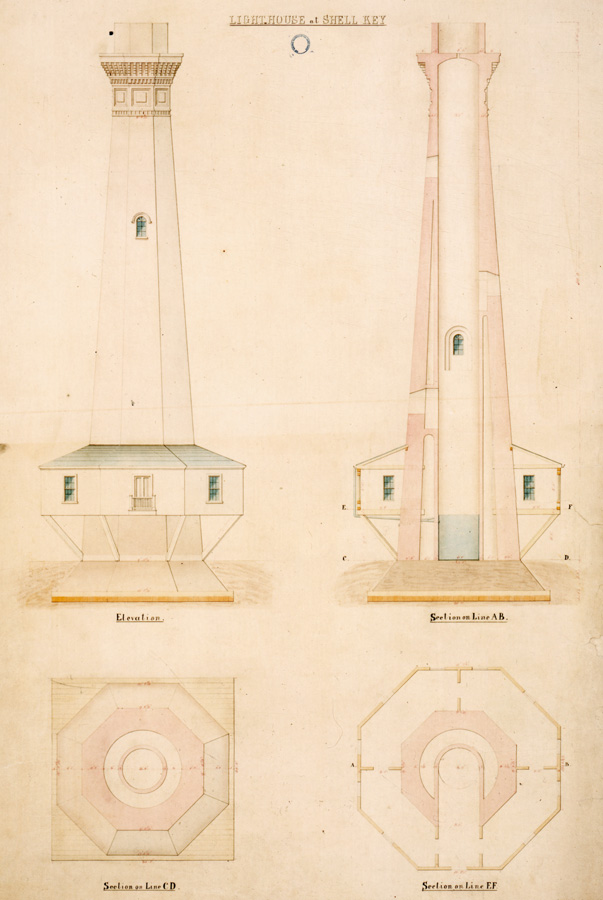
Construction proceeded during 1858, and officials announced that the lighthouse would be completed during the coming winter. The finished structure was an iron screw-pile lighthouse of striking appearance: a hexagonal skeleton tower rising from the extreme southern end of the keys, its framework forming the frustum of a pyramid with a cylindrical core. The tower stood approximately eighty-one feet above its foundation, with the focal plane of the light about seventy-one feet above mean sea level. A small keeper’s dwelling, elevated roughly nine and a half feet above the water, was incorporated into the lower portion of the structure. Illumination was provided by a third-order Fresnel lens, exhibiting a fixed white light visible in clear weather for up to fifteen miles. The use of a dioptric lens represented the Lighthouse Board’s continuing effort to modernize American coastal lighting and reduce fuel consumption while increasing luminous range.
Official notice was given on April 21, 1859, that Shell Keys Lighthouse would be ready for lighting on June 1. On that date, the light was placed in regular operation, three months before the completion of its companion tower on Southwest Reef. Contemporary notices carefully described its bearings and distances from Point Defer, Ship Shoal, and the entrance to Atchafalaya Bay, reflecting the importance of precise navigation along this treacherous coast.
Shell Keys Lighthouse quickly assumed a central role in Gulf navigation. Standing on the highest ground available in the keys—approximately ten feet above high water—it replaced the Vermilion Bay Lighthouse and the Atchafalaya light-vessel. For mariners threading the narrow margins between offshore shoals and the low Louisiana coast, the fixed white light became an indispensable reference.
The outbreak of the Civil War abruptly interrupted the lighthouse’s service. In the fall of 1861, Confederate authorities extinguished the light to deprive Union blockading vessels of its guidance. The lens, lamps, and lantern glass were removed and stored inland at St. Martinsville. For several years, the Shell Keys stood dark, a silent iron framework marking a coast otherwise unlit.
Following the end of hostilities, federal authorities moved quickly to restore navigational aids across the Gulf. In June 1865, Union sailors recovered the stored equipment at St. Martinsville, and the Shell Keys Lighthouse was repaired, refitted, and returned to service. On October 12, 1865, the fixed white light was again exhibited, its restoration noted with relief by mariners and inspectors alike. The lighthouse, along with Ship Shoal and Southwest Reef, was reported to be fully operational, reestablishing the critical chain of lights west of the Mississippi River.
Despite its modern design and careful maintenance, Shell Keys Lighthouse proved no match for the extraordinary hurricane that swept the Gulf coast on October 5 and 6, 1867. Contemporary reports described the storm as most violent at this exposed location. The iron screw piles were sheared off, and the entire structure collapsed into the sea. When the lighthouse tender Geranium later surveyed the site, scarcely a vestige of the costly tower remained; twisted fragments of ironwork were all that could be found, and the former position of the lighthouse lay beneath approximately four feet of water.
Tragically, Seth Jones, the assistant keeper on duty at the time, was lost in the storm. His body was never recovered, and no firsthand account of the lighthouse’s final moments survived. The principal keeper and another assistant, absent from the station during the hurricane, were spared.
The destruction of Shell Keys Lighthouse marked a grim milestone: it was the first tall iron skeleton lighthouse on the Gulf Coast to be completely destroyed by natural forces.
In the aftermath of the disaster, Lighthouse Board officials repeatedly urged Congress to fund a replacement. Estimates were submitted, and reports emphasized the severe impact of the light’s absence on commerce and safety. For several years, however, appropriations were not forthcoming. Finally, on March 3, 1869, Congress authorized $60,000 “for a new lighthouse at Shell Keys, to replace the one destroyed in the hurricane of the fifth and sixth of October, eighteen hundred and sixty-seven.”
Although officials announced that the lighthouse would be rebuilt at the earliest practicable day, competing post-war reconstruction priorities intervened. The appropriation ultimately lapsed into the surplus fund, and no new tower rose on the Shell Keys. Subsequent proposals—spurred in part by the discovery of salt deposits on nearby Petit Anse Island—never advanced beyond planning stages. An attempt to erect a replacement light farther south on Trinity Shoal ended in disaster in 1873, effectively closing the chapter on major lighthouse construction in this portion of the coast. Today, the Shell Keys lie within a national wildlife refuge, their sands shifting as they always have beneath wind and tide. No visible trace of the lighthouse remains. Yet in maritime records and coastal memory, Shell Keys Lighthouse endures as both a technological landmark and a poignant reminder of the human cost of maintaining lights at the edge of land and sea.
Keepers:
References