Head of Passes, LA 
Select a photograph to view a photo gallery


Photo Gallery


Photo Gallery
Photo Gallery
|
Pressure from Louisiana’s legislature led Congress to appropriate funds in September 1850 for a proper lighthouse at or near the Head of the South or Southwest Pass of the Mississippi River. A contract was let in 1851, and construction proceeded during the winter of 1851–1852. The resulting structure was an iron tower patterned after Biloxi Lighthouse, rising approximately sixty-seven feet—taller than the lights at the river’s primary mouths—yet paradoxically ineffective.
Head of Passes Lighthouse was intended to shine above the dense springtime river fog, but in practice it failed both ocean-going vessels and river traffic. From salt water it was invisible on even the clearest days, while river pilots could not steer toward it in the winding channel. Fog often rendered the light useless except for lookouts stationed high in ship masts.
There is some evidence that this iron tower was unique among American lighthouses. The contractor, John J. McCaughan of Mississippi City, submitted plans based on a British-export lighthouse erected at Barbados. Although Treasury officials rejected the original design due to insufficient plate thickness near the base, McCaughan was permitted to order heavier iron—apparently from a British foundry. If so, Head of Passes Lighthouse may have been the only lighthouse ever imported into the United States.
By 1853, the Lighthouse Board had decided to remove the iron tower entirely. Congress appropriated $6,000 to establish a smaller beacon at Head of Passes and to relocate the iron lighthouse to Pass à l’Outre, where it was rebuilt and re-lit in 1855. At Head of Passes, the keeper’s dwelling was modified with a dormer window displaying three reflector lamps upriver. In 1854, these reflectors were replaced by a quarter-fraction sixth-order Fresnel lens, marking the station’s early adoption of lens technology and reducing oil consumption by roughly half.
|
At the beginning of the rebellion, the original lighthouse was burned. In its place, the U.S. Navy established a battery within the station’s levee to deter blockade runners. A temporary sixth-order lens mounted in a brass housing was displayed from a timber tripod in January 1863. By April, a new wooden lighthouse with a fifth-order Fresnel lens stood on the original foundation, and the light was once again shown.
James Fisher, formerly keeper at South Pass, served as Union keeper during the war. By this period, Head of Passes had evolved into a major lighthouse depot supporting repairs throughout the Gulf Coast. Yet the environment remained hostile. Neglected levees washed away and had to be rebuilt, while annual floods sent massive trees crashing into the station. In 1866, brick piers supporting the gallery were destroyed by drifting logs, damage attributed to negligence by the keeper. Jessie Fisher, recently widowed, was dismissed, and a replacement was appointed.
The years following the Civil War were dominated by a continual struggle to keep the station from being swept away. By 1867, the dwelling rested on wooden posts after its brick piers were destroyed, gallery sills had rotted, and repairs were repeatedly interrupted—most notably by yellow fever. A protective shield against floating logs was installed, but erosion and wave action persisted.
In 1868, a major breakwater was completed in front of the lighthouse. The results were immediate and dramatic: river currents slowed, sediment accumulated, and the ground level rose by as much as two feet in a single year. Willows took root, further stabilizing the soil. By 1870, land that had once been navigable by rowboat had become firm, dry ground, and the threat of undermining appeared arrested.
Despite these improvements, erosion resumed. In early 1872, the lighthouse was moved approximately 200 feet inland after a gale destroyed much of the breakwater. By 1876, a new breakwater—built under a $3,500 appropriation—once again placed the station in good order. A fog bell operated by machinery was added in 1875, greatly enhancing the station’s usefulness during periods of low visibility.
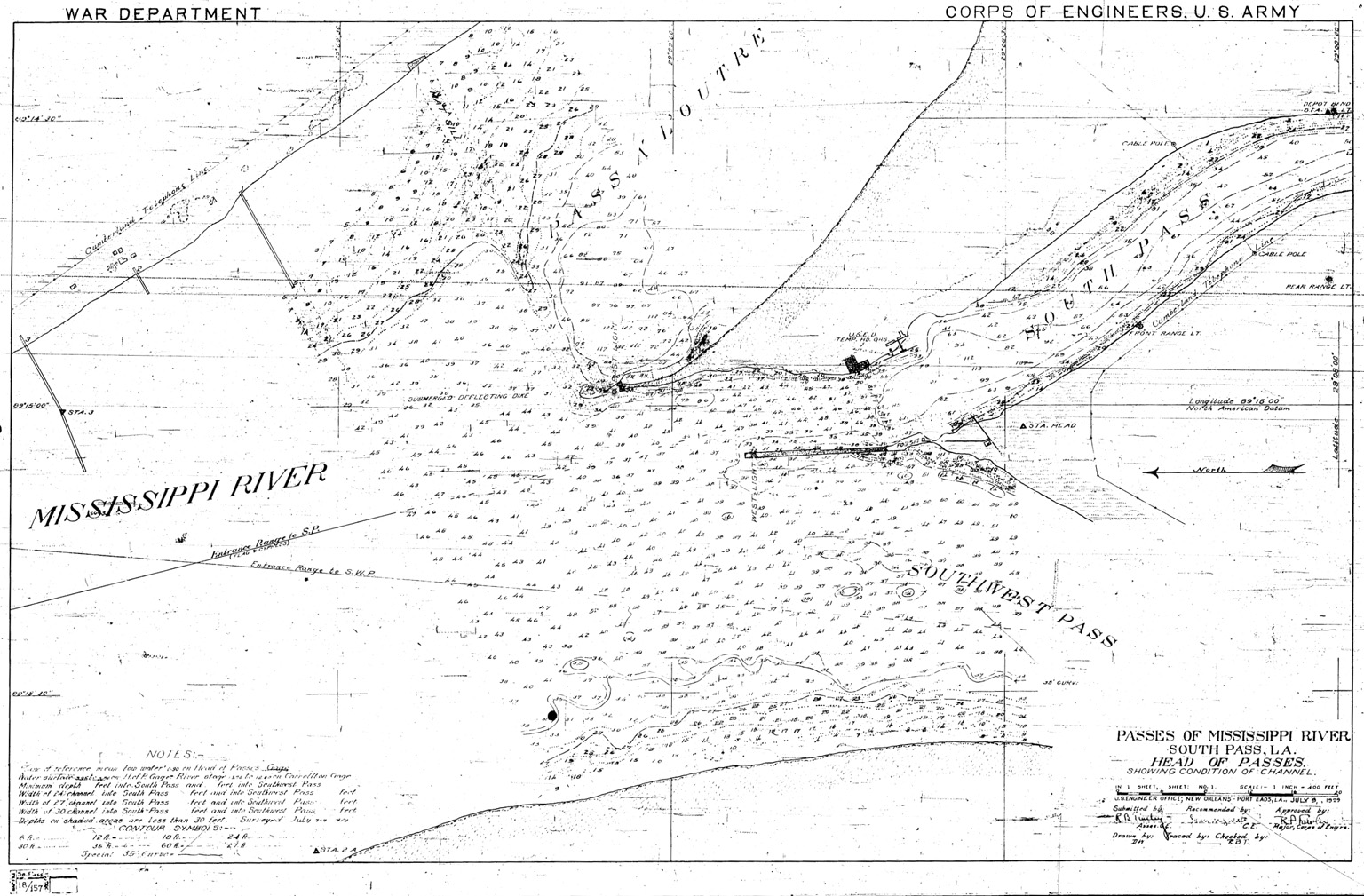
The late nineteenth century marked a gradual transition from lighthouse to service hub. The construction of jetties extending from Deer Island toward deep water shifted navigational emphasis away from the lighthouse itself. Beginning in 1878, pier-head and jetty lights were established at the entrances to the South Pass. By 1888, Head of Passes was officially regarded as a light attendant station rather than a primary navigational light.
|
In 1887, Louis G. Norvell, once a wealthy cotton broker, lost all his money and became a lighthouse keeper at Southwest Pass. He was promoted to first assistant at that station the next year, and then was placed in charge of Head of Passes Lighthouse in 1889. In 1891, Keeper Norvell drowned near Head of Passes. Margaret Norvell carried on her husband’s duties as head keeper while also caring for two children.
In October 1893, a powerful hurricane, now known as the Cheniere Caminada hurricane after it wiped out that settlement, devastated the Mississippi Delta, killing an estimated 2,000 people. “I could look into the swirling water and see people being swept by,” recalled Margaret. “I was powerless to help them.” Margaret opened up the lighthouse to refugees and cared for more than 200 people. In 1896, Margaret was transferred to Port Pontchartrain, where she looked after one lighthouse and then another until her mandatory retirement in 1932 at the age of seventy. The Cheniere Caminada hurricane was the worst disaster she witnessed in her forty-one years as a lighthouse keeper.
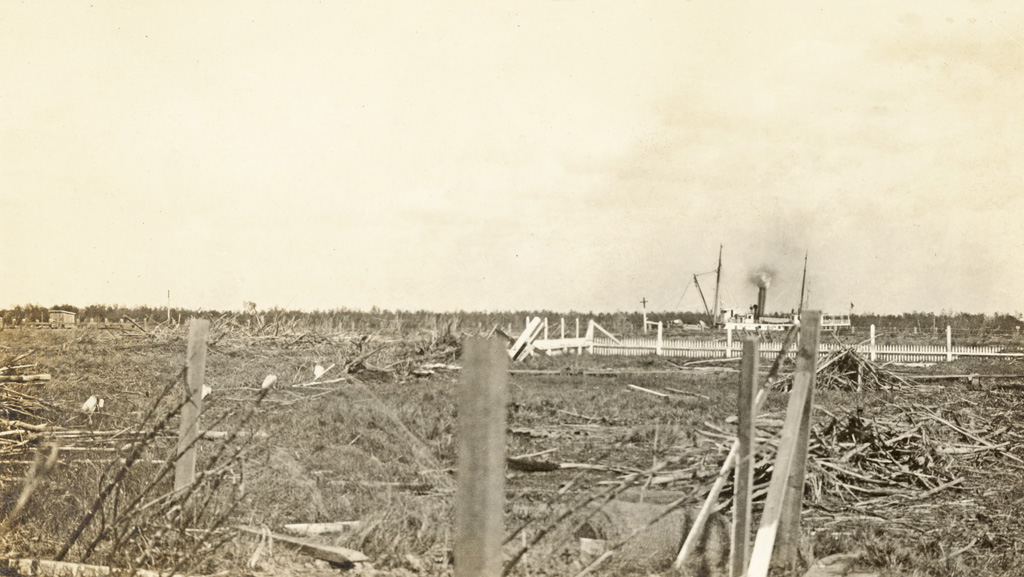
On Deer Island, the keeper’s dwelling, wharves, walks, cisterns, oil house, fencing, and fog-signal tower were repeatedly repaired or rebuilt. By 1899, the station boasted extended wharves, multiple plank walks connecting the dwelling to jetty beacons and fog-signal towers, a new boathouse with davits, and a relocated fog-bell tower equipped with an improved striking mechanism.
In the early twentieth century, the station continued to adapt. Storms and vessel collisions damaged wharves and structures, but repairs were routinely made—often at the expense of offending ship owners. In 1923, the fog signal was modernized, with an air diaphone replacing the bell and clockwork mechanism.
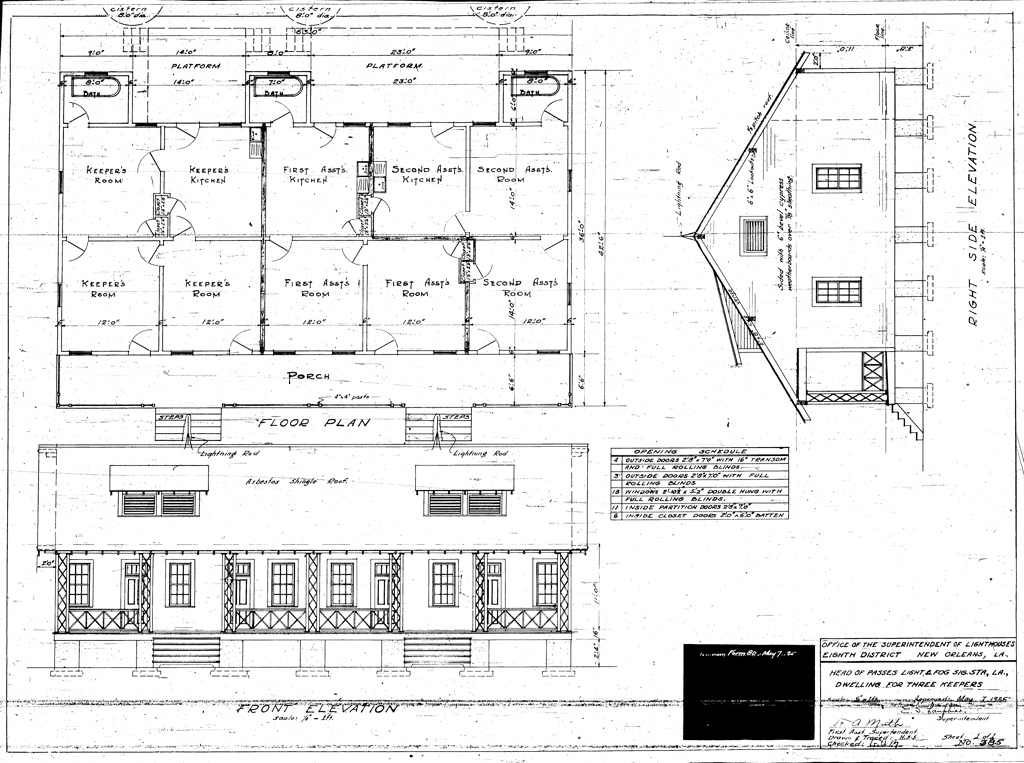
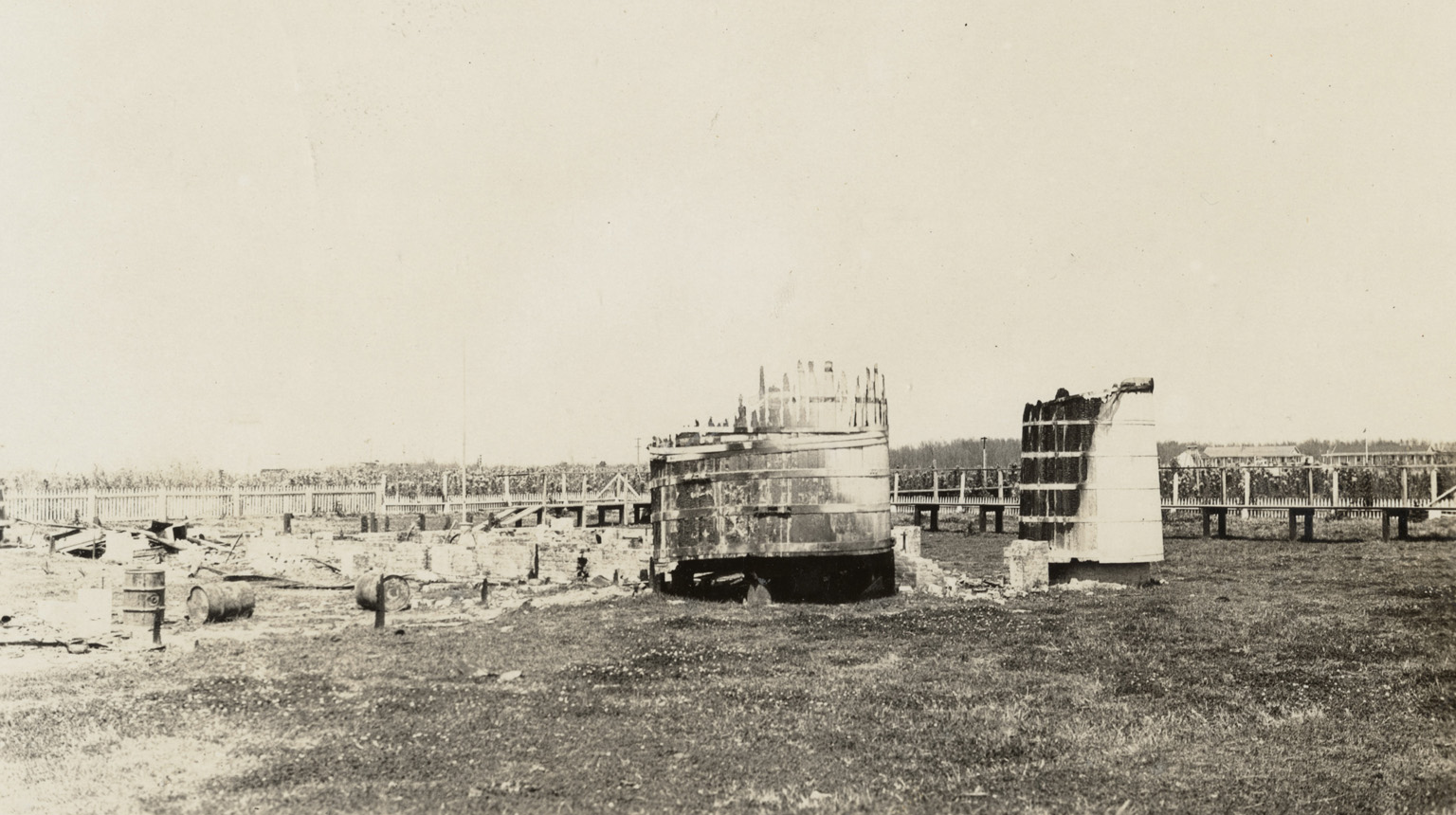
Disaster struck on December 11, 1924, when a fire destroyed the fifth-order light and the keeper’s dwelling. A new triplex residence was built the following year. First Assistant Frank Coludrovich fell off a plank walkway and broke his ankle during the fire and was paid by the U.S. Employees’ Compenstation Commission until he could return to duty in April 1926. As a result of his injuries, Coludrovich was lame the rest of his career.
Even amid challenges, the station’s keepers earned distinction. During hurricanes in 1915 and 1917, Keeper John W. St. G. Gibbon and Assistant Keeper Christian T. Thomasen maintained the lights under extreme conditions and carried out rescues. Thomasen later helped extinguish a fire threatening government property in 1918. Keeper Albert Matulich received lighthouse efficiency flags in 1919 and 1921, reflecting exemplary maintenance and operation.
Although no longer a traditional lighthouse guiding ships to sea, Head of Passes remained indispensable well into the twentieth century as a service, fog-signal, and maintenance station at one of the most dynamic points on the Mississippi River. Its history mirrors the river itself—constantly shifting, frequently destructive, yet essential to commerce and navigation. From its possibly foreign-built iron tower to its final role as a logistical hub amid jetties and fog signals, Head of Passes Lighthouse stands as a testament to the persistence required to maintain aids to navigation in one of the most challenging environments on the American coast.
Keepers:
References