Halfmoon Shoal, TX 
Select a photograph to view a photo gallery

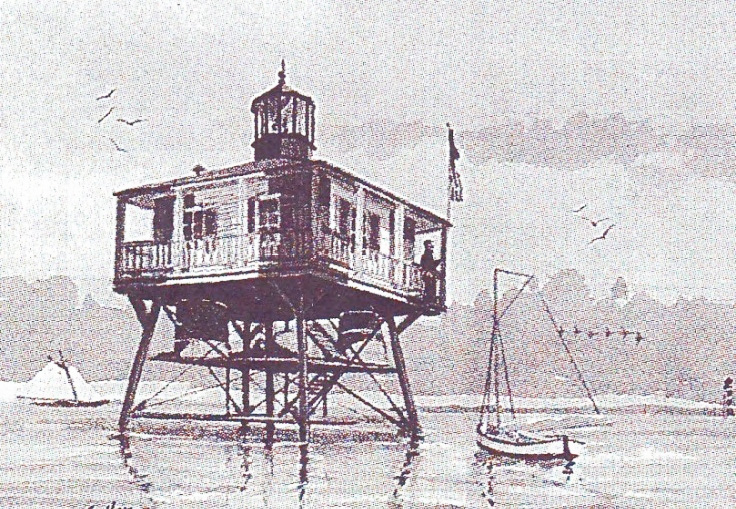
Photo Gallery

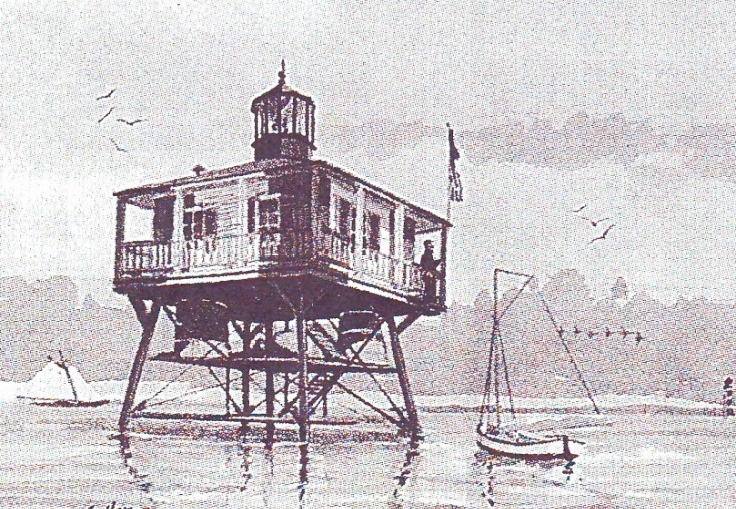
Photo Gallery
Photo Gallery
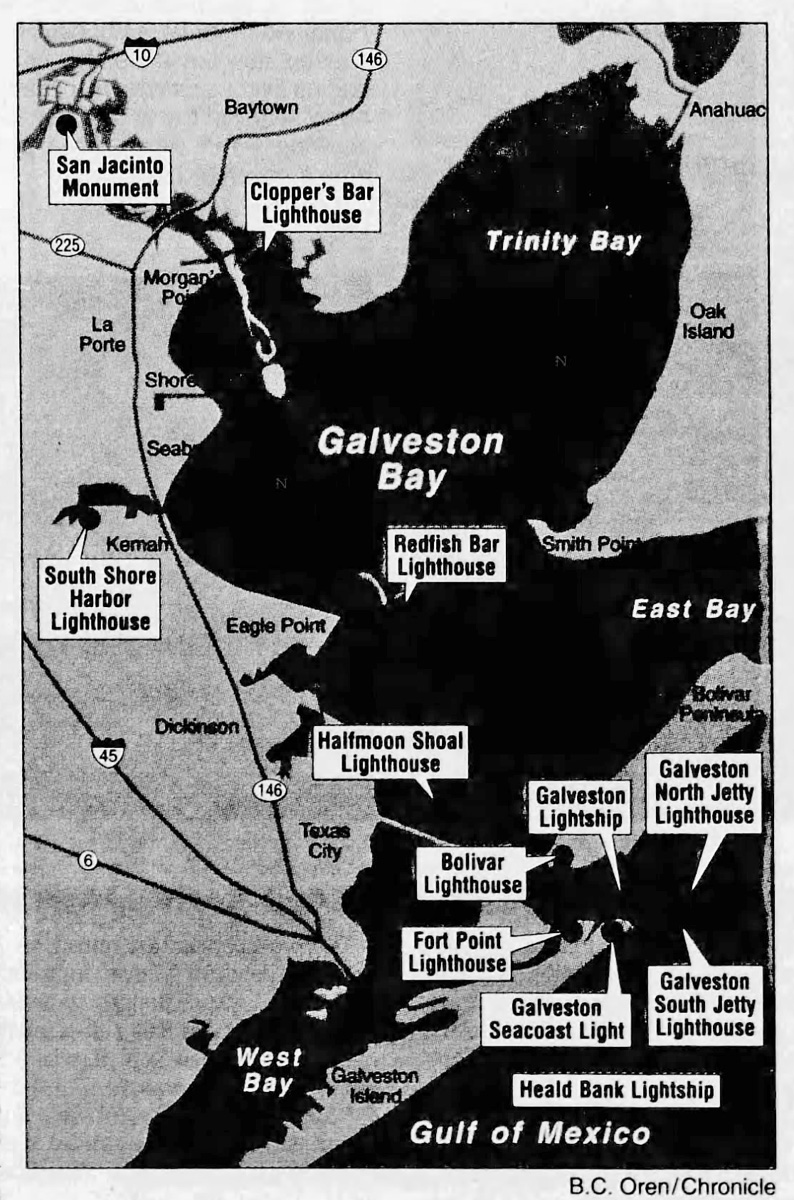
Among the most perilous of these features was Halfmoon Shoal, located between Pelican Island and Dollar Point, just north of the current Texas City Dike. Mariners approaching from the Gulf routinely crossed or skirted this shallow reef, which had already damaged or grounded numerous vessels. Early Coast Survey reports recommended that the bay receive a coordinated system of navigational aids, including fixed lights to mark the shoals and the deeper natural channels. In 1851, the Survey suggested a lightship for Halfmoon Shoal on the assumption that its bottom could not support a lighthouse foundation. However, an unusually low tide in 1852 exposed large sections of the shell reef, allowing a close inspection and revealing that a screw-pile foundation was possible.
|
In July 1853, the schooner Fulton arrived at Galveston from Philadelphia with the needed materials, and soon all three lighthouses were under construction. A detailed engineering report published in The Galveston News that year describes the innovative method used to erect these stations—one of the earliest applications of screw-pile lighthouse design in the United States.
The foundations consisted of hammered iron piles, each five inches in diameter and sixteen to seventeen feet long. A cast-iron helix—two feet across—was attached to the lower end of each pile. These piles were literally screwed into the shoal to depths of thirteen to fifteen feet, eliminating the need for massive stone foundations and providing remarkable stability in soft or shifting bottoms.
The Halfmoon Shoal foundation used five piles: four set at the corners of a twenty-five-foot square and one in the center. Cast-iron sockets, wrought-iron ties, and timber girts bound the structure into a rigid frame. Above this rose five yellow-pine columns supporting a twenty-eight-foot square platform, on which stood a twenty-foot square dwelling divided into four rooms. A cast-iron lantern atop the roof would house a sixth-order Fresnel lens, with the focal plane rising thirty-five feet above the bay.
Painted white with red corner trim, the lighthouse quickly became a familiar and important landmark for local mariners. On February 9, 1854, the lighthouse inspector formally inspected and accepted the three completed screw-pile beacons.
Daniel Davis was appointed the station’s first keeper in March 1854. Just three months later, he drowned while trying to return to the lighthouse. The Galveston Times of June 17, 1854 announced the tragedy:
The body of Capt. Daniel Davis, keeper of the lighthouse on Redfish Bar, was brought to this city yesterday at noon. The deceased came to his death, it is presumed, by falling out of a small boat as it neared the lighthouse, on Thursday evening. He left the city on Thursday in bad health.
As the Fresnel lenses ordered from France had not yet arrived, the Lighthouse Board ordered that the best hand lanterns should be used at once so the lights could be activated. The Board also had three pressed glass lens lanterns sent from New York to be used until the Fresnel lenses were received.
Records of damage to Halfmoon Shoal Lighthouse during the Civil War are sparse, but the station clearly suffered. By 1868, government reports noted that the “exigencies of the service”—a common phrase referring to shortages of money, materials, and manpower—had prevented progress in restoring the deteriorated structure.
In 1869, a full renovation was nearly complete when disaster struck. A steamer collided with the lighthouse, severely damaging the screw-pile substructure and bending several piles. The owners agreed to pay for repairs, and the station was finally restored soon afterward, with the light returning to service. Through the late nineteenth century the lighthouse received periodic repairs and improvements, evidence of continuous use and ongoing structural challenges typical of screw-pile stations:
John L. Smith was the longest-serving keeper at Halfmoon Shoal Lighthouse. He served at Clopper’s Bay Lighthouse from 1868 until that light was discontinued in 1880, and then transferred to Halfmoon Shoal, where he remained until 1898. George R. Smith replaced his father at Halfmoon Shoal Lighthouse in 1898, and then transferred to the lighthouse at Red Fish Bar, where he spent twenty-five years before retiring in 1924.
Nothing in the lighthouse’s long history compares to the devastation of the Galveston Hurricane of September 8, 1900, still one of the deadliest natural disasters in American history.
As the storm intensified, several vessels broke free from their moorings. The large British freighter Kendall Castle was repeatedly struck by drifting ships until a blow from the Norwegian freighter Cyller set it adrift. Driven by hurricane winds and storm surge, the 400-foot vessel tore across the bay toward Texas City—passing directly over the Halfmoon Shoal Lighthouse and obliterating it.
Keeper Charles K. Bowen, who had remained at his post, drowned. His body was never recovered. Tragedy deepened when it became known that Bowen’s daughter and granddaughter, who were ashore in Galveston, were also among the estimated 6,000 dead or missing. Keeper Bowen had entered the lighthouse service only the year before. Some sources indicate his father and wife also perished in the hurricane, but they both had died several years prior.
Federal records from 1904 document a claim submitted by the administrator of Bowen’s estate for the loss of personal property. The Lighthouse Board reviewed the case and recommended full reimbursement of $450.50, acknowledging the keeper’s service and the extraordinary circumstances of his death.
The Lighthouse Board quickly recognized the need to restore a navigational aid to the site. In 1902, a new Halfmoon Shoal beacon was constructed fifty feet north-northwest of the original location, standing in five feet of water.
This replacement was not a full dwelling but a square pyramidal structure built on iron-cased piles and covered with horizontal slats. It displayed a white lens-lantern light forty feet above mean high water. Though much simpler than the earlier screw-pile lighthouse, it ensured that Halfmoon Shoal once again had a reliable navigational marker.
In 1992, Charles T. Doyle, Mayor of Texas City, envisioned a replica of Halfmoon Shoal Lighthouse to display facts and photographs of the Texas City bayshore facilities and wildlife. After funding was provided by the Rotary Club of Texas City and the Texas Parks & Wildlife Department, a scale model of Halfmoon Shoal Lighthouse was built on the Texas City Dike. The pavilion was dedicated on April 4, 1998 and contains information panels on The Lighthouses of Galveston Bay, Texas City Dike & Ship Channel, The Port of Texas City, Birds & Wildlife of Texas City, Texas City Rainwater Drainage System, and Texas City Hurricane Levee.
Keepers:
References