Smith Island, WA 

Select a photograph to view a photo gallery


Photo Gallery


Photo Gallery
Photo Gallery
|
As navigation increased in the mid-nineteenth century, shipwrecks, fog, and errant currents made lighthouses essential. Among the second batch of eight lighthouses built on the West Coast were Washington’s Willapa Bay, Cape Flattery, New Dungeness, and Smith Island; Cape Disappointment had been part of the first batch of eight. Smith Island Lighthouse became operational on October 18, 1858, making it the last of the first sixteen West Coast to be activated. The fourth-order white light was elevated ninety feet above the sea and showed a flash every thirty seconds.
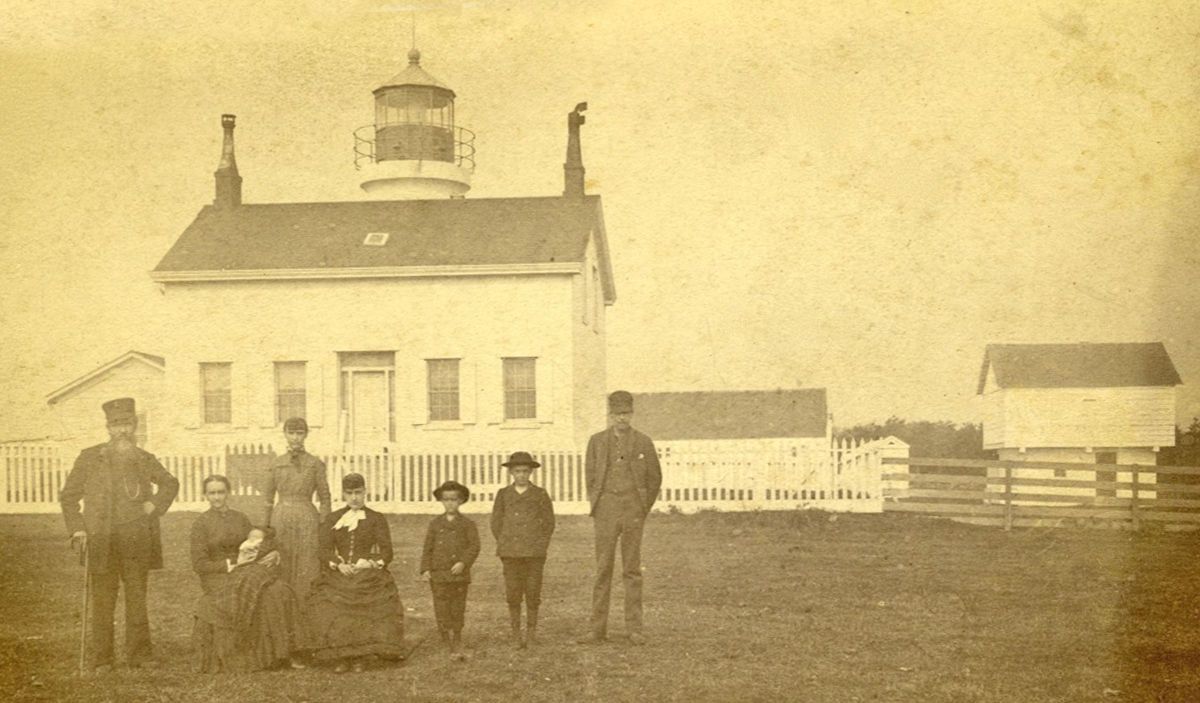
Designed in the classic Cape Cod–style typical of many early West Coast lighthouses, the original building consisted of a one-and-a-half-story keeper’s dwelling of thick masonry with a circular tower extending through the roof. Its footprint measured about twenty-five by thirty-five feet.
Not long after the lighthouse became operational, the station found itself at the center of a sensitive incident—sometimes called the “Battle of Smith Island.” In the spring of 1859, reports came into Port Townsend of a Haida canoe approaching, carrying women, children, and an elderly or ailing leader. Fearing a possible raid, local settlers detained the party—though no hostilities had occurred. This triggered a chain reaction: Indian agents intervened, and warnings of retaliation circulated. John Vail, the first head keeper of the lighthouse, and his wife Mary Jane, were evacuated from Smith Island, but Assistant J. R. Applegate remained to look after the light. A group of Haida landed on Smith Island and shot at Applegate, who returned fire, wounding one of the attackers and driving them away. Military volunteers under Major Granville Haller occupied the island briefly to forestall any additional conflicts. The incident remains one of the few documented early skirmishes involving a lighthouse and indigenous tensions in the Pacific Northwest.
Applegate resigned a few months after being shot at, and Mary Jane Vail was made the assistant to her husband. James Swan, northwest pioneer and historian, visited the Vails on Smith Island and found the lighthouse “a model of neatness.” Besides being a good housekeeper, Swan found Mary Jane “a lady of taste and charm,” who had “made a beautiful collection of marine curiosities.”
Over the ensuing decades, the lighthouse became more than just a beacon—it became home. Families lived, children were born, and generations passed in that lonely outpost. One of the longest-serving families was the Dennison family. DeWitt Dennison, who was wounded in the Battle of Wilson’s Creek during the Civil War, arrived as assistant keeper in 1880, relocating from Seattle with his wife and six children. In 1881, he was promoted to head keeper, and his wife Anna was made assistant keeper. Under their tenure, the light station saw some drama: fire, mechanical failure, rescues, theft, and death.
These various events were noted in the station’s logbook:
March 22, 1882 — At 8:30 a.m. the house was discovered to be on fire, at the west end, by the chimney. It was soon put out, not doing very serious damage. It was found, upon examination, to have taken fire on the inside, next to the chimney, and must have been smouldering some time before it broke out.November 1st, 1882 — At 10:40 p.m. the lens ceased to revolve. I was obliged to remove small pieces of glass which had broken and joined the revolving shaft so it could not move. I called my daughter to keep the lens turning while I repaired the machinery. I did not get it repaired until 2:30 a.m.
May 10, 1888 — At 1 a.m., a small fishing sloop went ashore on the spit. There was one man on board who was nearly drowned; two holes were knocked in the bottom of the sloop. My son, Frank Dennison, helped repair it and got it off.
August 21, 1891 — Boat stolen with three oars. I have done all I can think of to recover it and hope to get it yet.
September 3, 1891 — My son returned this evening with the boat; the finder claimed $20 finding fee reward. The boat was not injured and only had a little paint scratched off. My son went to Orcas Island for the boat.
October 27, 1891 — DeWitt Dennison, keeper of Smith Island Light Station, died and was taken to Whidbey Island and buried. Frank Dennison acting keeper.
Frank Dennison was soon officially appointed keeper and raised his family on the island. In January 1894, he recorded in the logbook discovering a derelict boat drifting one-and-a-half miles northwest of the island with a dead man aboard. There was no sign of foul play, and the body and the boat were taken to Port Townsend. Frank resigned in 1898, but returned to the island in 1904 as the assistant keeper. In 1905, he was transferred to Fairway Island Lighthouse in Southeast Alaska. He left the service in 1908 and tragically was lost at sea in 1911.
|
The keepers on Smith Island regularly assisted mariners. On July 28, 1914, Assistant Keeper Owen H. Wayson towed a motorboat with four occupants to safety. Keeper Bernard B. Meagher, who was in charge of the lighthouse from 1914 until 1925, had numerous rescues. On September 2, 1917, he took an officer from the disabled steamer Samson through rough seas in the station’s boat to get assistance. On February 28, 1920, he rescued three people from the launch Lucy Bell that had burned and took them to the mainland for medical attention. In 1922, he furnished food and lodging to five crewmembers of a hydroplane that landed near the station during a storm.
Harriet M. Meagher was paid to assist her husband during most of his time on the island and she too was credited with saving lives. On the morning of April 1, 1925, she noticed the peculiar action of a small launch that washed up on the beach. She went aboard and found two people unconscious from asphyxiation. With the help of men from the radio station that had been established on the island, one of the two was revived in twenty minutes and the other after more than an hour.
Keeper Meagher suffered an apoplectic stroke on Smith Island in March 1925 and was taken ashore for medical care. Harriet and her son looked after the light for several months until it was determined that Keeper Meagher would be unable to return to duty but would qualify for compensation on account of total disability.
The keepers at Smith Island were also exposed to the perils of navigating the surrounding waters. On December 29, 1939, Edwin G. Clements took the station’s rowboat to attend the failed light on Minor Island. Assistant Keeper Charles Bearman saw Minor Island Light go on for a few minutes, so believed Clements had reached the beacon. When Clements failed to return by midnight, Bearman radioed the Coast Guard cutter in Port Townsend for assistance. Bearman was able to walk out to Minor Island after the tide receded but found no trace of Clements.
Mrs. Bearman discovered the rowboat cast up on the island’s shore the next morning, but Clements’ body was not recovered until January 6, 1940. Edwin Clements had served as an assistant keeper at both Turn Point Lighthouse and Patos Island Lighthouse and had just recently replaced Charles Mykol as head keeper at Smith Island when the accident occurred. Keeper Mykol had tampered with the radio beacon equipment on Smith Island on a couple occasions, causing it to malfunction and necessitating mechanics to make repair trips. As a result, Mykol was transferred to Turn Point Lighthouse, where there wasn’t a radio beacon, and Clements was brought in to replace him. The Coast Guard noted that the transfer had been approved on November 2, 1939, but had not been “carried into effect prior to his death,” [even though Clements, his wife, and their flock of sheep were living on Smith Island], so the transfer was to be canceled.
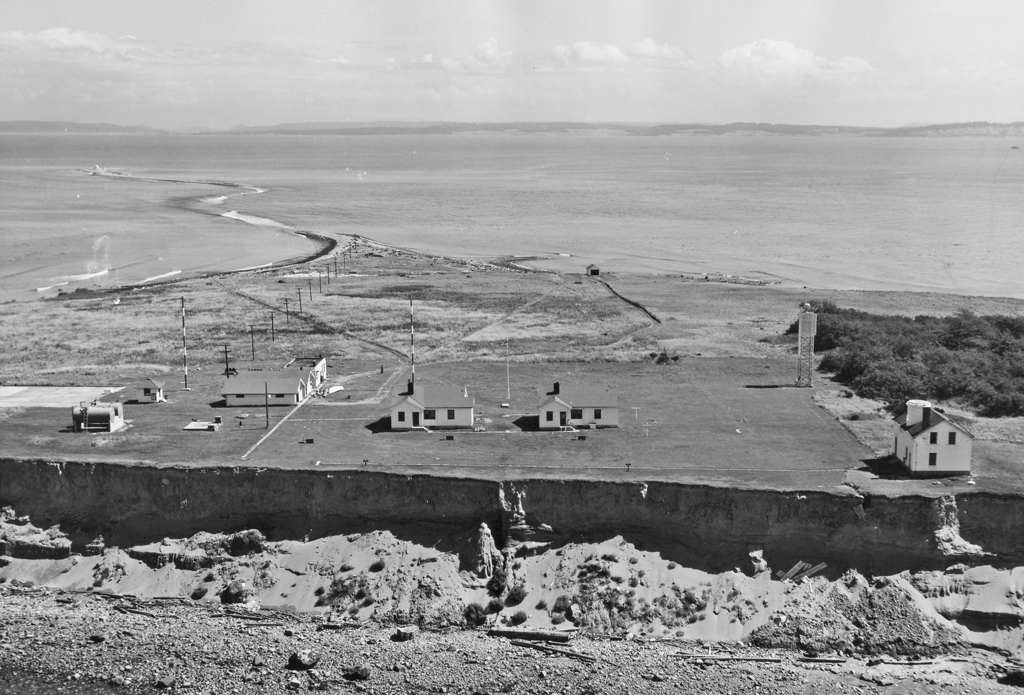
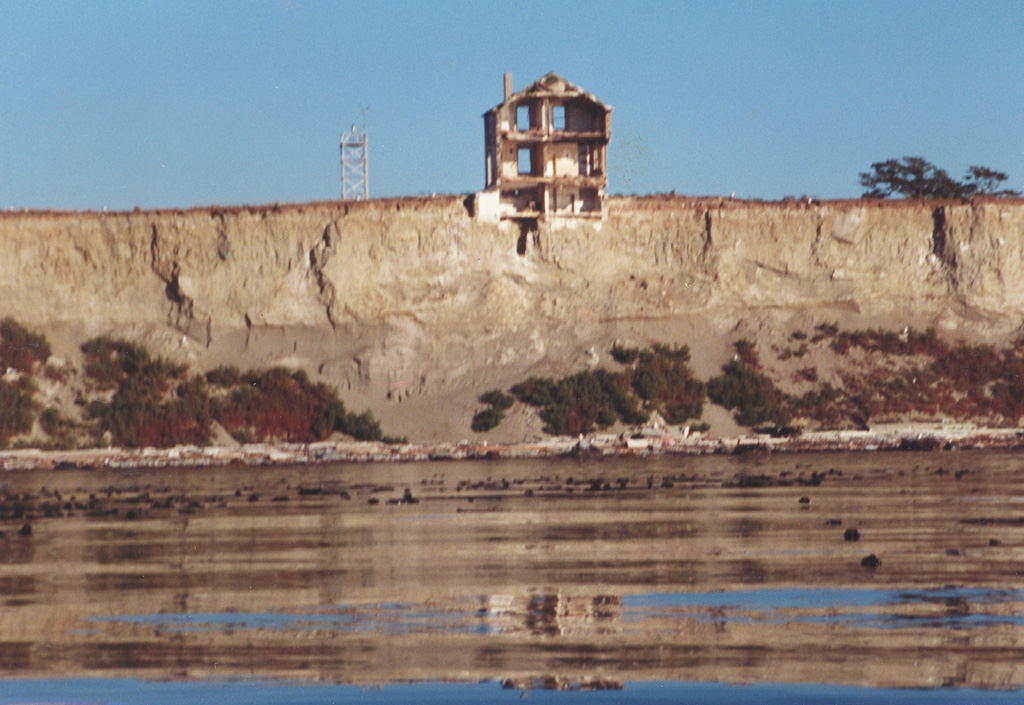
During its lifetime, Smith Island Lighthouse faced a relentless natural enemy: erosion. The tower had been built approximately 200 feet from the edge of the bluff—but the bluff was composed of sand, clay, and other relatively unstable material. Wind, waves, and storms gradually ate away at the cliff face. In 1878, the Lighthouse Board noted:
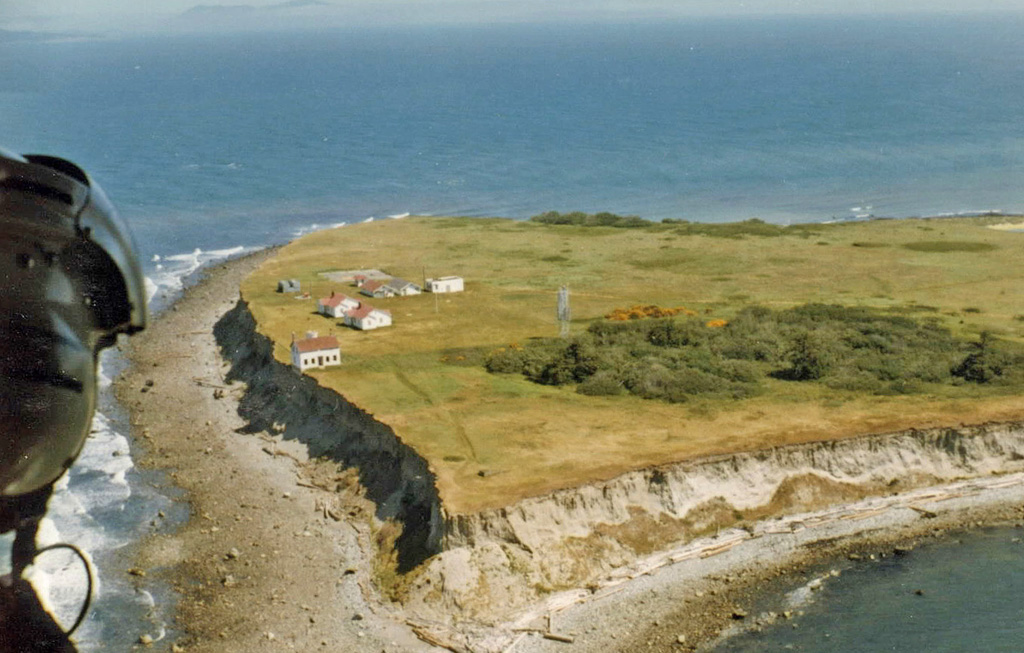
The sea is rapidly eroding the west face of the island, and the bank is continually caving. It is at present only about 160 feet distant from the dwelling, and if as much damage is annually done as has been done in each of the past few years, the sea will, unless an extensive breakwater is constructed, reach the light in about ten years.This prediction proved to be pessimistic, as the lighthouse would survive for over a century. By the early 1950s, the structure was nearly undermined, and the Coast Guard decided to abandon the lighthouse. A new light was established nearby on a skeletal metal tower in 1957, and modern dwellings were provided for the keepers.
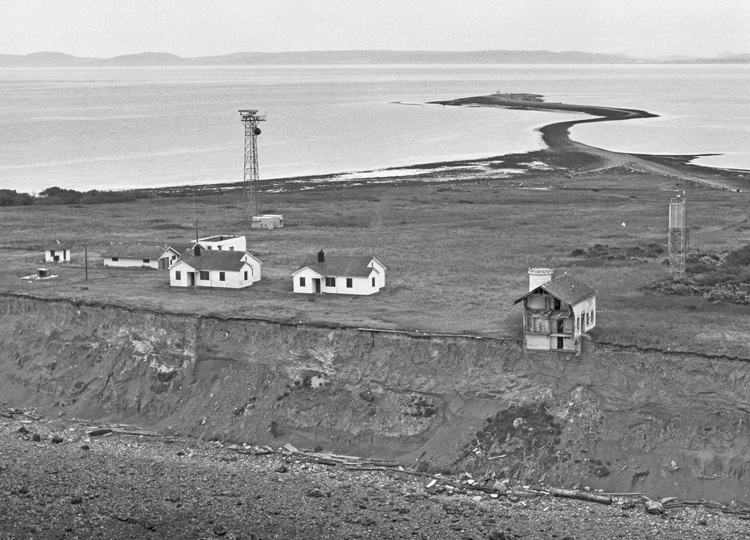
Over the following decades, pieces of the old house began to fall away. Photographs show the lighthouse foundation was right at the edge of the bluff in 1975. In 1982, just over half of the lighthouse was standing. In 1993, roughly a quarter of the lighthouse remained, and in 1998, the last surviving portion tumbled over the edge.
Though the physical building is gone, its memory persists in artifacts removed from the structure. In 1959, lighthouse author and historian Jim Gibbs was granted permission by the Coast Guard to remove the lantern room from Smith Island Lighthouse and placed it on his privately built Skunk Bay Lighthouse. The second Fresnel lens used in the lighthouse can be seen at the Museum of History & Industry in Seattle.
Today, Smith Island is part of the Smith and Minor Islands Aquatic Reserve. The island is closed to the public year-round, and visitors must remain 200 yards from shore. The Coast Guard still maintains an automated flashing light on the island.
Keepers:
References