Semiahmoo, WA 
Select a photograph to view a photo gallery
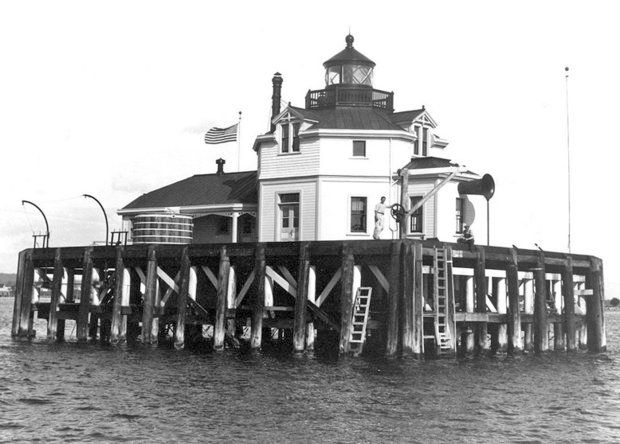
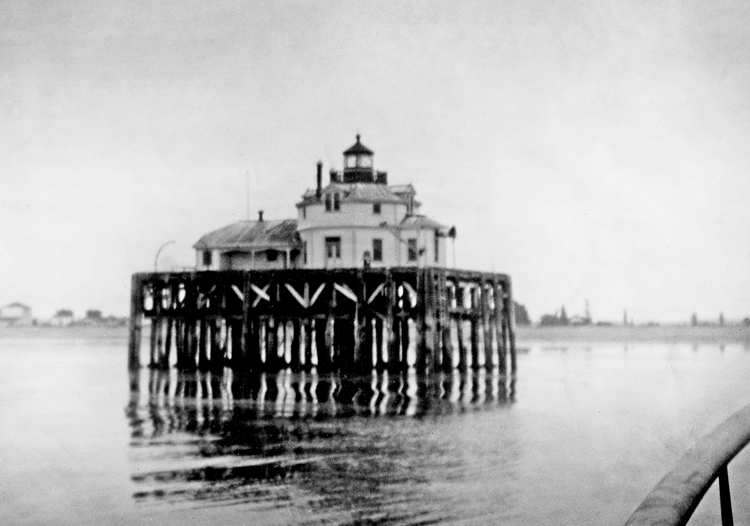
Photo Gallery
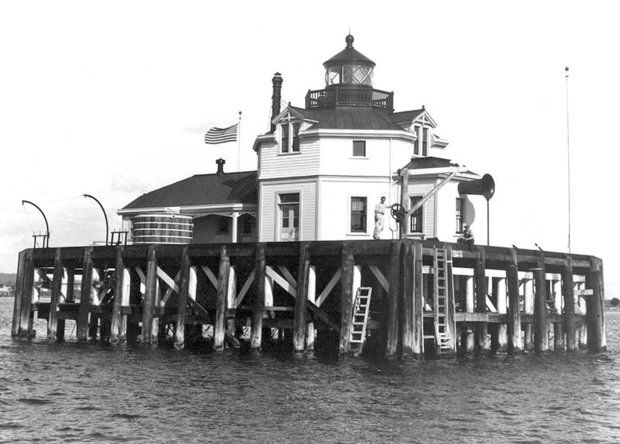
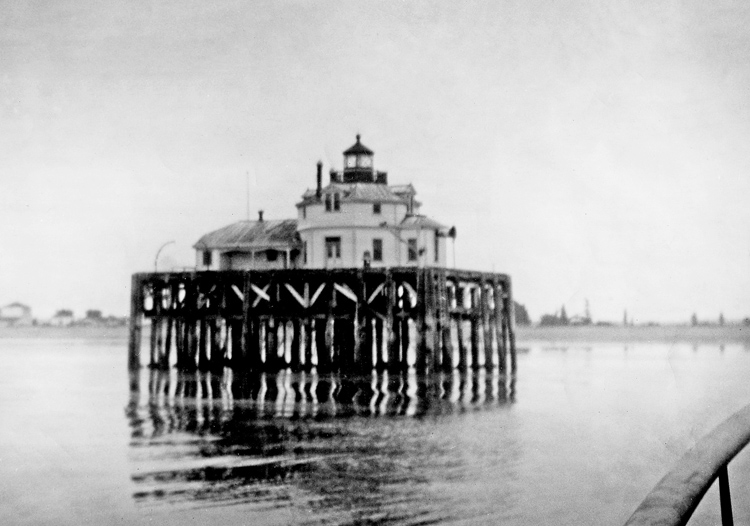
Photo Gallery
Photo Gallery
|
As local commerce increased, community leaders pressed for a permanent light and fog signal station at Semiahmoo. A petition to the U.S. Lighthouse Board originated in part through Orison P. Carver (postmaster of Semiahmoo), who had maintained an earlier rudimentary beacon. The Lighthouse Board acknowledged the need for a light and fog signal at Semiahmoo Bay in its 1897 annual report: “There is now a post light at Semiahmoo. While it is useful, it is insufficient for the needs of commerce. Blaine, the principal town in these waters, has a population of some 1,500, and certain lumber interests. At Semiahmoo, on the opposite side of the bay, which is narrow, there is a large cannery. Several lines of steamers from Vancouver on the north and Tacoma on the south touch at Blaine. During the fishing season this commerce is increased by vessels running in connection with the cannery. The harbor is difficult to enter, particularly at night. A small light and a fog signal would be of much service to commerce. It is estimated that they could be established for not exceeding $25,000, and it is recommended that an appropriation of this amount be made therefor.”
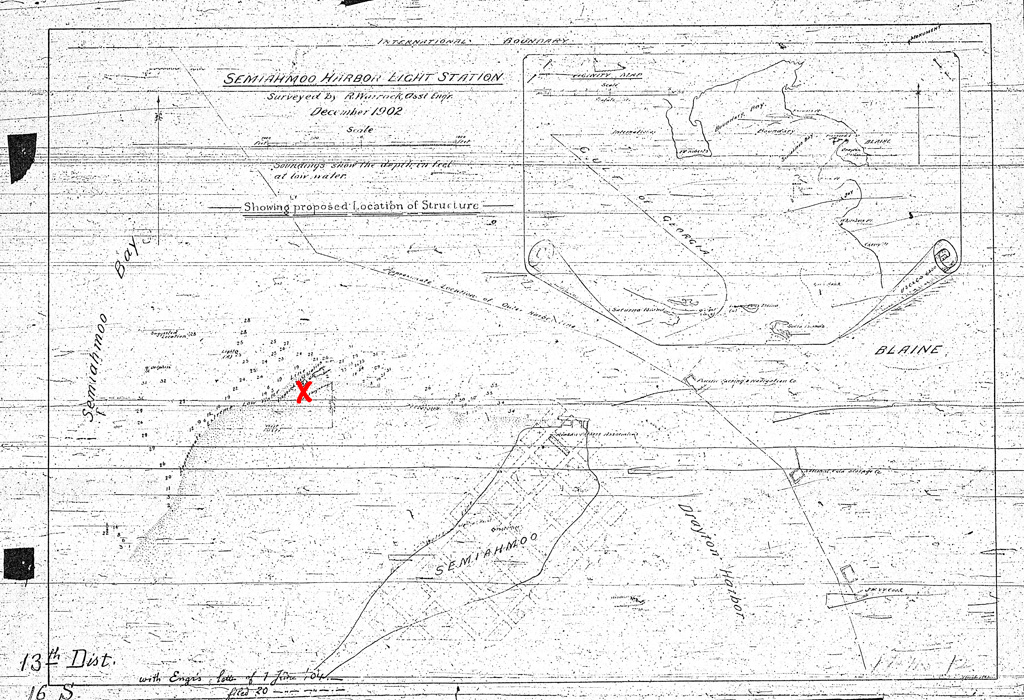
The Lighthouse Board repeated its request for funds to establish a light and fog signal at Semiahmoo in each of its subsequent annual reports until an act approved on June 10, 1902 appropriated the needed money. After a survey of the area was made, the Lighthouse Board approved the selected site on April 14, 1903 and decided to erect a lighthouse similar to the one built on Desdemona Sands, near the mouth of the Columbia River, the previous year.
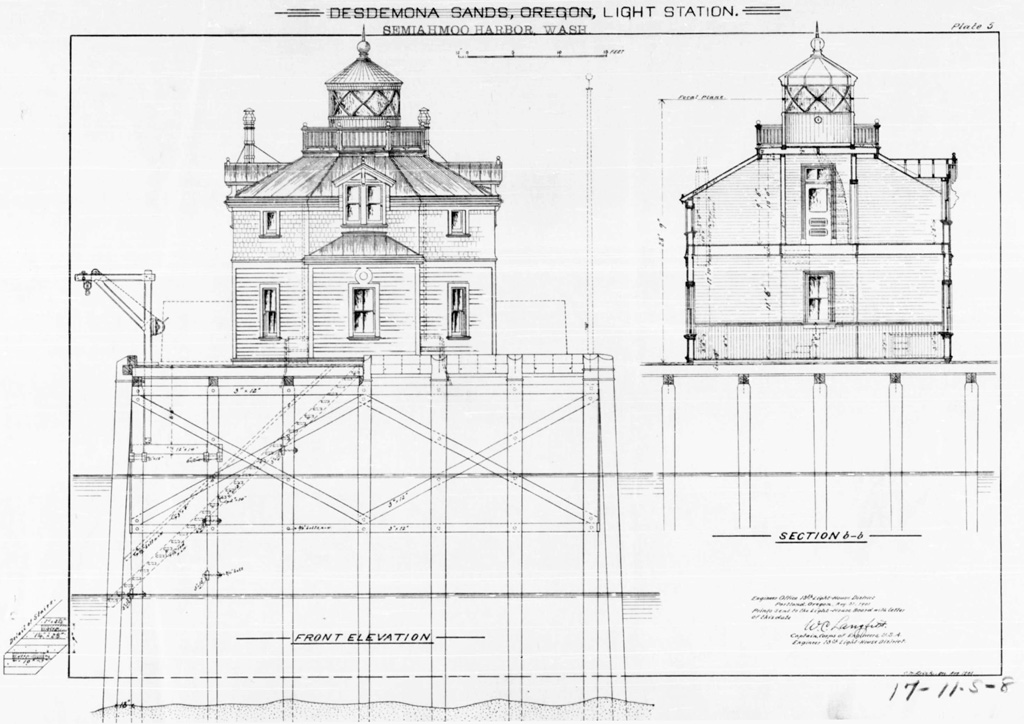
German-born architect Carl W. Leick, employed in the district offices of the Lighthouse Service in Portland, had drawn up plans for an octagonal lighthouse built atop a pile foundation for Willamette River Lighthouse in 1895. He modified and enlarged this design for Desdemona Sands Lighthouse, and these plans were then reused for Semiahmoo Lighthouse, as evidenced by “Desdemona Sands, Oregon” being struck through and replaced with “Semiahmoo Harbor, Wash.” on the drawings. The one-and-a-half-story, octagonal structure had a kitchen and fog-signal engine room on the main floor, three bedrooms and a storeroom on the upper story, and was attached to a rectangular, one-story structure that contained a fuel room, oil room, and privy. Two circular tanks on the platform held the station’s water supply.
The land for the planned lighthouse was condemned on January 10, 1904, and $50 in damages were awarded to the owner. An advertisement in various newspapers that spring notified contractors that proposals for constructing Semiahmoo Harbor Light Station would be received at the office of the lighthouse engineer in Portland until noon on May 31, 1904. Bids were opened that day, and a contract was made with Dundon Bridge and Construction Company of San Francisco, which had submitted the lowest bid of $14,883.
|
Semiahmoo Harbor Light Station—Located in three feet of water on the northwesterly point of the shoal, in the easterly part of Semiahmoo Bay, and on the southerly side of the entrance to Semiahmoo, Blaine and Drayton harbors.It is unlikely that the light was electric when established in 1905, as in 1912 its intensity was increased by changing the illuminant from oil to incandescent oil vapor. In 1914, a brass screen with an arc of ninety degrees that revolved on a plate was placed inside the lens to change the light’s characteristic to a white light with a five-second occultation every twenty seconds.About May 15, 1905, a fixed red light of the fourth order, illuminating 270 degrees of the horizon, the dark sector lying between west and north and covering the shoal and Drayton Harbor, will be established in the structure nearing completion at this station.
The light will be 41 ¾ feet above the water and will be visible 11 ¾ miles in clear weather, the observer’s eye 15 feet above the water. …
On the same date, there will be established in the structure a Daboll trumpet, operated by compressed air, to sound during thick or foggy weather blasts of three seconds’ duration separated by silent intervals alternately four and twenty-seven seconds, thus: Blast, three seconds; silent interval, four seconds; blast, three seconds; silent interval, twenty-seven seconds.
The structure is a white, one-and-one-half-story frame building, with gray trimmings and bronze-colored roof, located on a wharf 40 by 75 feet. A small one-story fog signal room extends from the southerly face, and a one-story wood shed and oil house from the northeasterly face of the structure.
Thomas E. Stanfield, who had previously been an assistant at Point No Point and New Dungeness, was appointed the first head keeper of Semiahmoo Harbor Lighthouse, with Orison P. Carver his assistant. Carver, who had maintained the previous light and was instrumental in getting the lighthouse built, left after just a few weeks.
In 1911, Keeper George L. Lonholt, who had been in charge of Semiahmoo Harbor Lighthouse for fourteen months, swapped stations with Keeper Edward Durgan of Patos Island Lighthouse. While at Semiahmoo Lighthouse, Edward Durgan had his son Clarence as an assistant for a couple of years and later his wife Estelle. Sixty-year-old Durgan died at Semiahmoo Lighthouse on March 20, 1919 of heart trouble. Estelle, who was his assistant at the time, tried in vain to signal someone. She was finally able to get word of her husband’s death to shore after three hours when a launch became disabled nearby. Keeper Durgan left behind his wife, six daughters, and two sons, both of whom were living in Alaska.
Estelle Durgan continued to serve as assistant keeper at Semiahmoo Lighthouse until she fell ill in February 1920 and was granted a month of paid sick leave. Estelle was so weak that she could not even sign a resignation letter. Robert Warrack, superintendent of the district, noted: “In all probability the present condition of [Mrs. Durgan] is due to the prolonged and almost hopeless struggle of raising a very large family at more or less isolated light stations on a meagre salary.” On Warrack’s recommendation, Estelle was given another month of paid leave and then her services were discontinued on April 30, 1920. Estelle eventually recovered from her illness and lived with her daughter for many years until her passing on November 4, 1943.
Keeper George Lonholt transferred back to Semiahmoo from Patos Island in 1922 and would be in charge of the station until an automatic light and bell were installed in 1939. The Coast Guard demolished the Semiahmoo Harbor Lighthouse in 1944 and established a new light in the form of a white pyramidal house on a pile structure in the vicinity. The local newspaper commented on the premature demise of the thirty-nine-year-old lighthouse: “It will be some time before local residents become accustomed to looking out over the water and not seeing the old familiar lighthouse.
Keepers:
References: